• One Equation for Faster-Growing Cells

    Biologists are obsessed with records.

    We like to learn about the smallest and biggest cells, the animals that live longest, and the birds which migrate furthest. Perhaps this is an intrinsic part of Human Nature; but a part of me — deep down — wants to resist it. I’ll not be a stamp collector, I think, or mere record keeper! No; I shall study the mundane and the average, such that I can understand life as it really is, or at least usually is, on this beautiful Earth.

    And yet, what’s the fun in averages? I think there is something about “records,” and our hunt for them, that serves a valuable purpose. Indeed, records are often a starting point for a deeper curiosity.

    When we learn of an organism that lives for hundreds of years, or first hear that elephants do not get cancer despite the abundance of cells in their bodies, it is only natural to think, “Wait, then why do humans get cancer? We have way fewer cells than elephants!” In this way, records become a starting point toward rich questions.

    But the record I think about most is cell division; specifically, why an obscure microbe — called Vibrio natriegens — is able to divide every 9.8 minutes and not a moment sooner.
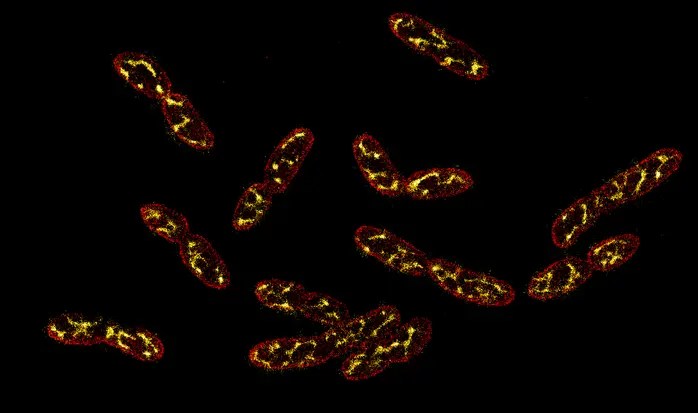
    Dividing V. natriegens cells. Credit: Max-Planck-Institut for Terrestrial Microbiology

    V. natriegens was first isolated by William Payne, a professor at the University of Georgia, from a glob of mud on Sapelo Island in 1958. Four years later, a man named R.G. Eagon incubated these cells at 37°C, shaking them vigorously in a liquid broth containing blended bits of brains and hearts. It was Eagon who found, in this experiment, that the cells divided every 9.8 minutes. This must have been a startling discovery, because the average microbe divides every three hours or so. Some microbes, living deep in the Earth’s crust, divide once every few years.

    It has been more than 60 years since Eagon made his discovery, and yet nobody has found a microbe which grows faster than V. natriegens. Is 9.8 minutes some kind of magical threshold; a speed limit to life’s replication? I don’t think so. And the reason I say so is because of a single equation, the parameters of which may actually reveal how to make cells grow faster.

    False Assumption

    My first assumption was that a cell’s division time is limited by DNA replication. For one cell to become two, the cell must copy its genome and pass one copy to each offspring. The bigger the genome, the longer it takes to make a copy, and the slower a cell divides. Right?

    Not quite. The enzyme responsible for copying the genome, called DNA polymerase, moves at roughly 1,000 bases per second. V. natriegens has about 5.17 million bases in its genome, split across two chromosomes. The first chromosome has 3.25 million bases, and the second has 1.93 million bases. At normal speed, one polymerase would need 54 minutes to copy the first chromosome and 32 minutes to copy the second.
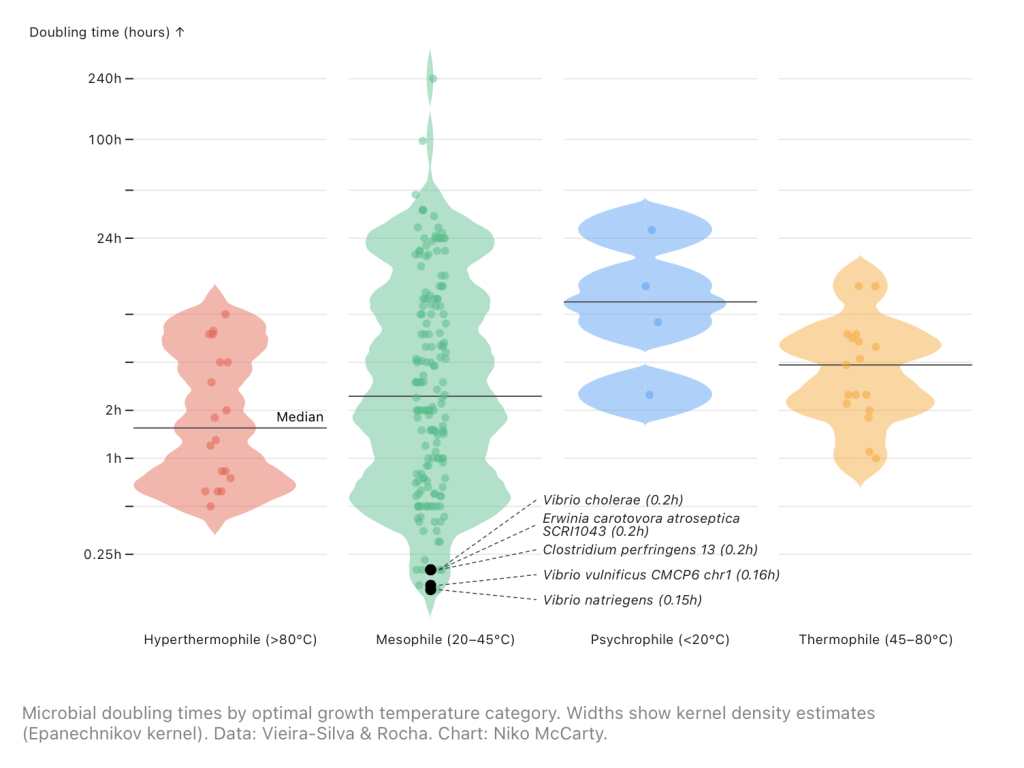
    Doubling time for 214 microbes, organized by their optimal growth temperature.

    For years, many researchers thought that splitting the genome across two chromosomes was what enables V. natriegens to grow fast. With two chromosomes (so their thinking went), two polymerases can copy the genome in parallel, thus cutting division times in half! But then a 2024 paper came out, explaining how researchers had fused both chromosomes into a single genome, and the cells still divided every nine minutes. So clearly that’s not the bottleneck here.

    The truth is that cells don’t use a single DNA polymerase to copy their genomes. Instead, two polymerases copy the genome at the same time, albeit in opposite directions. This bidirectional copying also happens many times simultaneously. As soon as one set of DNA polymerases begin copying the chromosome, another set latches on and starts copying it, too. Multiple copies of the genome are thus in the act of being made at any given moment. When one cell becomes two, each “daughter” not only inherits a genome, but also inherits the copies of that genome that are in the act of being made.

    DNA replication is not the bottleneck to cell division. In theory, a cell could initiate dozens of rounds of DNA replication all at once, provided it has enough energy and nucleotides to do so.

    The true bottleneck, it turns out, are actually the ribosomes, or big “machines” (a tired metaphor, I know) that build proteins. Before a cell can split in two, it must double its pool of ribosomes so that each daughter cell has enough to survive. And as we’ll see, this is really slow.

    Many students are taught to think of ribosomes as “proteins that build other proteins.” But two-thirds of a ribosome’s mass is RNA; not amino acids. Each ribosome is also built from two pieces, called the large and small subunits. These two pieces glom onto a strand of messenger RNA and “read” its code to build proteins. After a ribosome has finished making a protein, it falls off the messenger RNA, searches for a new strand, and begins building the next one.

    E. coli and V. natriegens have nearly identical ribosomes. In both, the small subunit contains a long strand of RNA, called ribosomal RNA, packed inside of 21 proteins. The large subunit has two strands of RNA (one short and another long) stuffed inside of 33 proteins. Of all the RNA molecules floating around a cell, about 80 percent are ribosomal. (Messenger RNAs account for only a tiny fraction.) In total, each ribosome contains 4,566 nucleotides of RNA and 54 separate proteins, totaling 7,500 amino acids. This is enormous; an average protein has about 300 amino acids. Once built, each ribosome can “stitch together” about 16 amino acids per second.

    Now, I know there are a lot of numbers here. But recall that V. natriegens divides every 9.8 minutes, and consider what happens when we crunch the numbers on how long it takes a ribosome to build a copy of itself:

    There are 7,500 amino acids in a ribosome, and each ribosome stitches 16 amino acids together each second. Therefore, it takes one ribosome about 7 minutes and 50 seconds to build another ribosome; and V. natriegens divides every 9.8 minutes! That gap of about two minutes is all the time the cell has to make everything else: copying DNA, growing its lipid membrane, and building all the other proteins it needs to survive. Ribosome biosynthesis is the true bottleneck on cell division. No organism can divide faster than the time it takes to make its own ribosomes.

    If this explanation strikes you as too tidy, though, you are certainly not alone. I had the same reaction at first. And one question I began thinking about is this: Sure, it takes one ribosome about eight minutes to make one ribosome. But each cell has tens of thousands of ribosomes. Those ribosomes all work together, in parallel, to make more ribosomes. Because the 7,500 amino acids required to build each ribosome are split across 54 different proteins, 54 ribosomes could (in theory) work together to build each new ribosome.

    But this is only true at the level of one ribosome. If we zoom out to the whole cell, the math doesn’t work out quite this cleanly. For a cell to go from R ribosomes to 2R, it must build R ribosomes, and it only has R ribosomes to do this. Each ribosome, on average, must make one other ribosome; and that takes about eight minutes.

    (Parallelization works when you can add more “machines” independent of output but, in this case, the “machines” are also the output.)

    CategoryMetric Value
    DNA PolymeraseSpeed~1,000 bases/second
    V. natriegens GenomeTotal size5.17 million bases
    Number of chromosomes2
    Chromosome 13.25 million bases
    Chromosome 21.93 million bases
    Replication Time (single polymerase)Chromosome 154 minutes
    Chromosome 232 minutes
    Cell DivisionV. natriegens division time9.8 minutes
    Ribosome CompositionTotal ribosomal RNA4,566 nucleotides
    Total proteins54
    Total amino acids7,500
    Ribosome SpeedTranslation rate~16 amino acids/second
    Time for one ribosome to build one ribosome7min 50sec

    This raises other questions, too; like rather than fully double its ribosome pool, why doesn’t a dividing cell give fewer ribosomes to each daughter?

    A cell could do this. But doing so would mean each daughter cell then needs to “catch up” and make more ribosomes so it can grow at its maximum capacity again. Cells must devote about half **their ribosomes toward making the various proteins needed to sustain life (not ribosomes). If a cell devotes too many ribosomes toward making other ribosomes, it will not be able to sustain its metabolism, or make energy, or copy its genome, or all that other stuff. Short-shifting daughter cells, then, is just passing a problem down to future generations.

    So the ribosome bottleneck holds, no matter how we come at it. But this makes V. natriegens’ growth rate even more impressive. This microbe, pulled from a glob of mud in Georgia, has evolved a way to divide quite close to its theoretical, biophysical limit; mostly by optimizing for ribosome biosynthesis.

    First, V. natriegens has at least a dozen ribosomal RNA operons, or gene clusters encoding ribosomal RNA molecules, in its genome. E. coli, for comparison, has seven. And second, these ribosome genes are located next to “strong” promoters, or genetic sequences that recruit RNA polymerase enzymes. In other words, Vibrio devotes more of its genome to ribosomal genes, and has also evolved a stronger “start” signal for those genes, meaning the cell makes ribosomal RNA much more frequently, and in higher numbers, than other microbes.

    Scientists don’t fully understand why V. natriegens evolved to grow quickly, though. But remember that these cells were first discovered in nutrient-rich mud, on an obscure island off the coast of Georgia, where lots of organic matter washes up with the tide. As this tide flushes out, nutrients go with it. In their natural environment, then, these cells are exposed to ebbs and flows of nutrient-rich soup; cells that divide faster are able to “scoop up” more nutrients before it disappears. The end result, over millions of years, is that cells evolve to grow and consume as quickly as possible.

    I can’t help but wonder why evolution “stopped” at 9.8 minutes, though, rather than the eight minutes it takes to theoretically double the ribosome pool. Those extra two minutes, it turns out, come from the fact that a dividing cell must make not only ribosomes, but also many other proteins, before it divides. A cell needs to make all the enzymes required for DNA replication, proteins to “pull apart” the chromosomes for each daughter cell, lipid molecules to grow the cell membrane, and so on. All of these things require proteins, which are made by ribosomes. And that’s why ribosomes can’t spend all their time making other ribosomes! (Even at maximum growth rates, most microbes only devote about one-third of their ribosomes toward making more ribosomes. The rest are used to build other things.)

    Still, I wonder if cells could grow even faster.

    Math “Knobs”

    The interesting thing about essays is that they describe phenomena in the English language, and thus are imprecise by their nature. I can work really hard to edit my sentences and make my words as clear as possible, but there will always be a chance that you, my reader, will be confused. Or, I could just simplify everything by giving a single equation which captures and explains the whole phenomenon. It turns out that this works remarkably well for cell division.

    A few years ago, researchers at Caltech published a paper, titled “Fundamental limits on the rate of bacterial growth and their influence on proteomic composition.” In it, they write down two simple, mathematical relationships. First, they note that the fraction of a cell’s mass devoted to ribosomes depends on how many ribosomes it has (of course) and how big those ribosomes are, relative to all the proteins in the cell. And second, for a cell to double in size, it must synthesize a cell’s worth of new protein, and the rate at which ribosomes do this determines how fast the cell grows.

    By smashing these two relationships together, they arrived at a single equation — with just four parameters1 — that describes how quickly a cell will divide:

    λ=rtfaΦRLR\lambda = \frac{r_t \cdot f_a \cdot \Phi_R}{L_R}

    The left side, λ, is the cell’s growth rate, or number of times it divides per hour. On the right, there are four terms. rt is the translation elongation rate, or the speed at which a ribosome puts amino acids together; in most microbes, this is 15-30 amino acids per second. fa is the fraction of ribosomes actively making proteins at any given moment. In a normal cell, at a narrow slice of time, about 15 percent of all ribosomes are idle. ΦR is the ribosomal mass fraction, or percentage of all proteins in the cell that are ribosomes. And LR, on the bottom, is the total number of amino acids in each ribosome.

    The beauty of this equation — the reason it nearly brings a tear to my eye — is because it immediately explains both the biophysical limits of cell division and the knobs, or “dials,” by which we can change it. We can intuit, for example, that f_a must always be less than 1.0, because some ribosomes will always be between jobs, searching for their next strand of messenger RNA. And ΦR must be less than 1.0, too, because a cell made entirely of ribosomes is a cell without a metabolism, membrane, and so on. Both of these parameters have hard ceilings.

    To get a feel for what’s biologically plausible, let’s plug in some back-of-the-envelope numbers for V. natriegens:

    rt = 20 amino acids per second
    fa = 0.85 active ribosomes
    ΦR = 0.50 of protein mass is ribosomes
    LR = 7,500 amino acids per ribosome

    Crunching these numbers, we get λ = 4.08 h⁻¹, or a doubling time of 10.2 minutes; remarkably close to what Eagon measured in 1962!2

    The nice thing about mathematical equations, like this, is that they not only point at biophysical limits, but also reveal which parameters can be tweaked to change the results. Now that we know the four parameters which set growth rate, in other words, we can begin to dream up clever ways to tune each “knob” to make cells grow faster or slower.

    One option is to engineer ribosomes such that they literally build proteins faster. If we could raise the rt parameter to 30 or more (as some other microbes have), then division time goes down. Or, alternatively, we could try and make ribosomes smaller. Researchers have already explored this for E. coli. In 2002, researchers studied which proteins — of the 54 found in the E. coli ribosome — were “conserved” across other bacteria, archaea, and eukaryotes. In other words, they wanted to figure out which proteins show up again and again across species, and which proteins were only found in a few species (and, thus, might be disposable.) 

    They found that about 21 of E. coli‘s ribosomal proteins show up in bacteria, but not archaea or eukaryotes, and some could plausibly be trimmed. I’m not aware of anyone who has actually tried this, but I wouldn’t be surprised if we could cut out, say, 20 percent of the ribosome without impacting its function too much, and thus shave a couple minutes from the theoretical cell division time. Somebody should try this!

    Another option is to raise fa by boosting the fraction of “active” ribosomes within the cell. Protein synthesis is the most energetically expensive thing a cell does, so many organisms have evolved mechanisms to shut ribosomes down when they are not needed, thus conserving energy. E. coli, for example, carry “hibernation factors,” proteins that grab onto ribosomes and push them into an inactive form when they are not needed. It’s not known if V. natriegens encode the same proteins, but we could search through their genome and delete similar genes to test this theory.

    Or, perhaps, we could take a more agnostic approach and just let evolution take its course, albeit in an accelerated way. If Vibrio evolved with slow ocean tides, maybe we could make them evolve even faster in the laboratory. Perhaps we could run a Richard Lenski-esque experiment, in which V. natriegens’ cells are grown in a robotic bioreactor and flooded with glucose every few hours, followed by stretches of nutrient starvation. If we repeat this lots of times, some microbes may evolve to grow even faster during those periods of high glucose. Or maybe not; V. natriegens may already be quite close to the theoretical cell division time limit.

    These experiments haven’t been done yet. But that, in a way, is the whole point. 

    I never planned to write this essay, which emerged entirely by accident, with one question leading to another, until I found myself deep in the weeds of ribosomes and biophysics and growth rates. What surprised me most, in the end, was that the clearest answer to my question was found not in words, but rather in a single equation with just four parameters. Biology, at its limits, can often be described best with mathematics.

    This equation only exists because generations of biophysicists heard about a record set by a microbe pulled from Georgia mud in 1958 and couldn’t let it go. They spent decades modeling ribosome fractions and translation rates; not because anyone asked them to, but because the record raised questions which bothered them and they wanted desperately to answer. Eventually, they wrote down an equation that not only explains why V. natriegens divides as fast as it does, but points toward how we might push it further still.

    Records, it turns out, are not merely trivia, but rather a map toward the loose threads that, when pulled, unravel something remarkable about the world. In glorifying the exceptional, we can find answers to the mundane.

    1. A typical E. coli has 75,000 ribosomes and V. natriegens has 115,000 ribosomes. But why? The equation also helps explain why this is. The gist is that cells can’t just crank up ribosome speed indefinitely, because there is a maximum rate of protein biosynthesis. The only way to grow faster, then, is to make more ribosomes. But the downside of this is that, by making too many ribosomes (especially when nutrients are scarce), the cell’s amino acids will get depleted and the cell will slow down. Therefore, cells must carefully balance their ribosome numbers to match their available nutrients. This also explains, somewhat, why larger cells — even of the same species — divide more quickly; they are using the extra space to house more ribosomes. ↩︎
    2. Cells grow exponentially; each division yields two cells, each of which divides again. Therefore, the actual doubling time is not 60/λ, or roughly 15 minutes, but rather ln(2)/λ, or about 0.693/λ. Hence the 10.2 minute figure. ↩︎
  • eLife Fallout

    In October 2023, shortly after the war in Gaza began, scientist Michael Eisen shared an article from the satirical news website, The Onion, on Twitter. Entitled “Dying Gazans Criticized For Not Using Last Words To Condemn Hamas,” Eisen retweeted and added: “The Onion speaks with more courage, insight and moral clarity than the leaders of every academic institution put together.”

    At the time, Eisen was editor-in-chief of an open-access science journal called eLife. Ten days later, he was fired. After five of the journal’s editors resigned in protest, eLife’s board of directors released a statement: 

    Mike has been given clear feedback from the board that his approach to leadership, communication and social media has at key times been detrimental to the cohesion of the community we are trying to build … It is against this background that a further incidence of this behavior has contributed to the board’s decision.

    This happened more than two years ago. At the time, it received extensive media coverage. Some news articles celebrated the decision, while others quoted sources who criticized the journal for their “irrational attack” on Eisen’s freedom of speech. But never explained — at least not by the mainstream press — were details about the precise events and academic in-fighting that preceded Eisen’s ousting.

    Eisen was not fired because of a tweet, says Prachee Avasthi, who served on eLife’s board of directors. Rather, tensions had been mounting for months between eLife’s leadership team and its editors and readers. The journal had spent years pushing the boundaries of both publishing and peer review. eLife first required authors to publish preprints before submitting to the journal, and then they got rid of accept-reject decisions entirely. Eisen increasingly found his decisions at odds with the norms of the scientific community he was trying to reform. So when Eisen sent out his tweet, says Avasthi, the board just had a convenient excuse to get rid of him.

    The whole story is quite strange, especially given that the people involved — not only Eisen and Avasthi, but also former editors at the journal — still regularly cross paths in San Francisco’s open-science community. Even as eLife fractured, the same ideas and people reassembled elsewhere, carrying forward pieces of the original reform efforts. Conversely, the journal has quietly retreated from parts of the vision Eisen laid out for it.

    Origins of eLife

    eLife was designed as an experiment in removing gatekeepers from scientific publishing.

    Founded in 2012, eLife quickly joined the ranks of “prestige” journals because three famous research charities — the Howard Hughes Medical Institute, the Max Planck Society, and the Wellcome Trust — agreed to fund a large portion of its operations. From the start, this support meant that eLife didn’t have to worry about the financial pressures that often plague academic journals, which otherwise rely on large subscription and article-processing fees for survival.

    The journal’s first editor-in-chief was Nobel Laureate Randy Schekman. In 2013, Schekman criticized Nature, Science, and Cell as “luxury journals,” comparing their low acceptance levels with high-end “fashion designers” who deliberately inflate demand due to perceived scarcity. Just 8 percent of papers submitted to Nature are eventually accepted.1 (eLife’s acceptance rate in 2025, for comparison, was 15.4 percent.)

    Under Schekman, the journal began implementing reforms to remove gatekeepers and give authors more control over decisions. In mid-2018, eLife began requiring that authors post their manuscripts on preprint servers, such as bioRxiv, before submitting to the journal. The goal, as Eisen explained, was to show that journals could act as reviewers rather than as judges. “The main reason for doing that,” Eisen says, “was to show that publishing wasn’t our job. We were reviewing papers that authors had already published themselves.”

    The second major reform at eLife was to do away with accept-reject decisions entirely, thus making editors more like academic collaborators than gatekeepers.

    This was a big change, at least compared to the conventional publishing model. When scientists submit a paper to Nature, say, it is first assigned to an in-house editor, who decides whether a submission meets the journal’s standards. According to Nature’s website:

    The criteria for a paper to be sent for peer-review are that the results seem novel, arresting (illuminating, unexpected or surprising), and that the work described has both immediate and far-reaching implications.

    These criteria don’t leave room for null results, incentivizing authors to overstate the merits of their work. If the editor thinks that a paper fails to meet this bar, they can unilaterally reject it. If the editor thinks that it does meet this standard — and there is usually a bit of politicking involved — then the paper is sent to two or three peer reviewers.

    The reviewers usually take 2-3 weeks to read the paper and write feedback. Their reports return to the editor, who decides whether the manuscript should be rejected, revised, or accepted. Most papers go through at least two rounds of review. The full process can take months or years. 

    Reviewers may give differing opinions about a paper, too. Reviewer #1 might ask the scientists to repeat an experiment, while Reviewer #2 commends it and tells the editor to accept the paper as-is. This can get quite confusing, of course. But at most journals, the editor compiles and returns all of the reviewers’ feedback — conflicting or not — to the authors, who must then decide whether to revise their manuscript or send it elsewhere. The editors usually wield final authority over which studies appear in the journal.

    But since its inception, eLife — seeking to improve this peer review process — had adopted something called “consultative peer review,” meaning reviewers and editors talked to each other before sending back a single set of non-conflicting comments to the authors. Unlike most other journals, in a show of transparency, eLife also openly published the decision letters and reviewer reports for all accepted articles. (In a 2016 survey, 95 percent of reviewers said that “that the consultation process at eLife adds value for authors.”)

    In mid-2018, under Schekman’s tenure, eLife launched the Triage Trial, an experiment that removed accept-reject decisions for roughly 300 papers. Editors and reviewers still gave authors feedback, but eLife then published those comments whether or not the authors revised the manuscript or resubmitted it to a different journal. In other words, eLife became a peer review platform, rather than a typical publisher with yes-no decisions. “If we publish reviews for all papers, then why do we need an accept or reject decision at all?” Eisen says. “There was no good argument for only publishing the reviews of accepted papers.”

    Each of these decisions — from the shift in peer review, to requiring that authors post their studies on preprint servers, to eliminating accept-reject decisions — moved eLife closer to its ultimate aim of putting authors, rather than editors, in control of publishing. 

    Schekman resigned from his position in early 2019, and was replaced that February by Michael Eisen, a geneticist at UC Berkeley. Eisen had previously founded the first open-access journal, the Public Library of Science (PLOS), in 2001. The board interviewed five candidates, says Avasthi, and the finalists were Eisen and a “more moderate” choice. But Eisen received unanimous support among the board’s selection committee.

    At the same time, everybody at eLife knew that Eisen was not a politically neutral choice. Eisen has urged scientists to access papers via SciHub, “a shadow library that provides free access to millions of research papers, regardless of copyright,” according to Wikipedia. (Many scientists do this anyway, but it’s kind of a “you’re not supposed to talk about it” situation within academic circles). In 2018, Eisen also ran for a U.S. Senate seat in California, tweeting an image of Donald Trump with the caption, “What a fucking asshole.”

    In October 2022, based on results from the Triage Trial, eLife — now under Eisen — announced that they would scrap accept-reject decisions across the entire journal. From now on, editors would only screen submissions for serious flaws, and then pass them to outside experts for review. These reviewers would write a public report and, with the editor, an accessible description of what the study showed. eLife would then post both the paper and these reviews — even scathing ones — online as a “Reviewed Preprint.” Authors could then revise and repost their paper through eLife or resubmit elsewhere.

    “By relinquishing the traditional journal role of gatekeeper and focusing instead on producing public peer reviews and assessments, eLife is restoring control of publishing to authors,” Eisen wrote in a public letter. Avasthi, a member of eLife’s board of directors, was fully supportive of Eisen’s vision. Rejecting papers often felt arbitrary, she says, since those same studies would later appear in other journals anyway.2 “So why reject it? We realized these processes just slow things down and remove author agency.”3 (For a 2012 paper, researchers found that about 75 percent of all submitted papers are published in their first-choice journal. Of those papers that do get rejected, a majority are later published elsewhere.) 

    At the same time, eLife changed its revenue model. Previously, authors paid $3,000 only if their paper was accepted. Most other journals also charge authors only upon acceptance, meaning that the more selective they are, the more money they lose reviewing papers. Instead, eLife began charging a flat fee of $2,000 for all submissions. Critics saw this as opportunistic, but it directly tied the fee to a service: namely, peer review.

    With each change, eLife moved closer to Eisen and Avasthi’s ultimate goal of “a world where journals might not even need to exist.” Scientists would get to choose when and how to share their work, but without being able to hide criticisms by quietly re-submitting rejected work to other journals. The scientific community would then organize around studies or reject them conceptually, based on these public reviews, rather than promoting studies merely because they appeared in a “prestigious” journal.

    But then tensions started mounting.

    The Gatekeepers’ Demise

    For a while, eLife appeared to navigate this publishing shift successfully. Initial reactions were positive, submissions were steady, and the leadership team felt optimistic that other journals might follow their example.

    But then, in early 2023, with eLife poised to fully implement their new policies, a group of prominent editors — including Schekman — began voicing concerns, according to reporting in Nature. In private letters, nearly 30 senior editors threatened resignation, arguing that removing the accept-reject decision would undermine the journal’s prestige and compromise peer review standards. The board also began to question their ideas, then quietly postponed their scrapping of accept-reject decisions.

    Stephen Heard, an evolutionary biologist and writer at the University of New Brunswick, was one of eLife’s most vocal critics. Heard argued that eLife’s policy wasn’t even particularly radical; the journal still charges fees, screens submissions, and “is mostly a journal — just one with a 0 percent rejection rate for manuscripts that make it to the peer-review stage.” 

    Heard also suggested that publishing “unrevised” papers would shift the function of scientific quality-control onto readers. By removing power from editors, readers would need to evaluate the merits of papers themselves. This could be problematic, he claimed, because not all readers have the time or expertise needed to judge a paper’s quality.

    Mark Hanson, professor at the University of Exeter Penryn, applauded eLife’s courage but thought the move was “bad for the health of science … a push towards the death of expertise.” In his view, eLife hadn’t killed gatekeeping, but had instead swapped “hard” editorial power for “soft” influence: 

    Before, editors gave a binary accept/reject. Now they give an implicit accept/reject. I doubt authors will actually publish articles as final version of record [sic] if they’re totally trashed in the editor statement. But it frees up authors in that grey area to publish anyways, even if the editor and reviewers aren’t fully endorsing the article … 

    eLife remained publicly supportive of Eisen. In an editorial, the board and a few editors urged researchers to give the model a chance. “It is a very exciting time at eLife as we try to push the frontiers of publishing and navigate the challenges along the way,” wrote Deputy Editor, Tim Behrens

    But scientists continued to worry about submitting manuscripts to the journal. They wondered if papers published there would “count” for their career. If eLife was no longer accepting or rejecting articles, would universities and hiring committees treat them in the same way as other published articles? There was concern that papers in eLife would be viewed as “lesser than” articles published in standard journals.

    In March 2023, twenty-nine eLife editors and Schekman, the former editor-in-chief, wrote a letter to the executive editor of eLife’s non-profit owner, Damian Pattinson, urging him to replace Eisen “immediately,” according to reporting in Nature

    They added that they had no confidence in Eisen’s leadership because he had dismissed their concerns and had not considered compromise positions. One of the journal’s five deputy editors had already stepped down from that leadership position, and ‘significant numbers’ of reviewers and senior editors were ‘standing ready to resign.’ they wrote.

    The eLife board published an open letter in response, reiterating support for the new model. But despite this public show of support, members of the board privately worried. 

    In group chats and emails, Avasthi said, several board members were discussing the blowback from scientists “on a daily basis” and fielding “daily complaints from powerful scientists.” Avasthi, who was then Chair of the board, felt like her colleagues were not doing enough to support Eisen, especially given the fact he was merely championing decisions that the board, themselves, had already made. In late March, Avasthi resigned from her position. A few months later, Eisen wrote the infamous tweet that got him sacked. “I think the truth is that they had grown sick of me,” he says:

    [The board] didn’t want to deal with the reality of what [reform] actually looks like, which is that people were going to get upset. People were going to say, ‘I am never publishing in eLife anymore.’ People were going to accuse us of ruining science. People were going to attack us. So the practical consequences of trying to actually do something, as opposed to pretending to do something, is not easy and it’s not pleasant.

    End of the Impact Factor

    ​​After Eisen’s firing, eLife tapped its two deputy editors, plant biologist Detlef Weigel and neuroscientist Tim Behrens, to run the journal through 2024 while the board looked for a permanent leader. Weigel and Behrens’ first task was crisis control: reassuring skittish editors, calming authors, and keeping the accept-reject system alive.

    In October 2024, however, a company called Clarivate announced that eLife would lose its Impact Factor, a metric invented in the 1960s to help librarians select subscriptions from a growing number of scientific journals. In the last couple decades, universities have increasingly treated Impact Factors as a shorthand for prestige. Most scientists call the metric “stupid” or “arbitrary,” yet still try to publish in journals with high numbers because university hiring committees — as well as grant reviewers at major institutes — care about it.

    An Impact Factor is calculated by taking the number of citations on papers published by the journal in a given year, divided by the total number of papers published. If Nature published 100 papers that collectively netted 2,000 citations in a year, for example, then its Impact Factor would be 20. In 2023, eLife’s impact factor was 6.4. 

    Clarivate’s decision to remove the journal’s Impact Factor hinged on a simple concept: If the journal was not making accept-reject decisions, then there was no way to tag a paper as officially being “in” the journal, and so Clarivate could not fairly calculate the metric. Even before Clarivate made this decision public, the company had flagged eLife’s listing as “On Hold;” university librarians also noticed that some eLife papers had quietly disappeared from Web of Science, a paper indexing platform created by Clarivate. Authors began to worry that their eLife papers would become hard to find and, therefore, difficult to cite.

    In response, the board made a partial compromise: The journal would send papers above a certain quality threshold (submissions designated as “solid” or higher in the eLife editorial assessments) to be indexed in Clarivate’s Web of Science. But publicly, the journal protested, arguing that Clarivate’s move would stifle “attempts to show how publishing and peer review can be improved using open-science principles.” Critics, including Avasthi, viewed eLife’s decision as a capitulation; as a way of bringing back accept-reject decisions, albeit in a different form. 

    By early 2025, Behrens — now permanent Editor-in-Chief — insisted eLife would press on even if it lost its Impact Factor entirely. “We want to prove you can succeed without that number,” Behrens wrote to staff. But submissions to the journal have dipped significantly, especially from scientists in geographic regions where metrics are a deeply entrenched part of academic evaluation, such as in China and the United States. (Submissions from Europe dipped only slightly, according to Behrens.) eLife fully lost its impact factor in June 2025.

    Even so, eLife refused to return to the old system. “Our job is to take the risks now so other journals can copy what works, with much lower risk,” says Behrens. “Any experiment that plays by different rules from Clarivate will hit the same breakpoint” as his journal experienced. 

    Instead, the journal would lobby universities, funders, and scientific societies to state publicly that eLife papers (and papers published in other journals that follow their model) will count just as much as Impact Factor papers. On 8 May 2025, eLife publicly stated on their website:

    We’ve spoken to funders and institutions around the world and found that more than 100 (over 95% of respondents) still consider eLife papers in research evaluation despite eLife’s exclusion from the journal Impact Factor.

    “We’ve conflated sharing science with judging scientists,” says Behrens. “Decoupling them is the whole point.”

    Conclusion

    Despite the upheaval, eLife remains a great journal. Its decision to get rid of accept-reject decisions did not condemn it to obscurity. The journal still publishes thousands of articles yearly and is widely respected amongst scientists. Articles average a speedy 95 days between submission and publication.

    But still, as the journal decided first to require preprints and then to remove power from its editors, scientists wondered: Why not just do these experiments at another journal? Why “tank” the prestige of eLife itself?

    The reason, says Eisen, is that the journal carried weight; it was considered prestigious. “The only way to address the reliance on a journal’s brand as a proxy for quality was to take a recognized signifier and destroy that signification,” he says. “We wanted to remove reliance on that brand.” 

    A spin-off journal, lacking the same measure of perceived prestige, would be ignored by the scientific community. The whole point was to run this experiment in a big journal, in other words, so that people would pay attention.

    eLife’s decision to remove accept-reject decisions, and the backlash that ensued, also reveals the difficulties with metascience reforms as a whole. It shows how everything in academia is intertwined. When one pulls a single thread, like accept-reject decisions, the whole fabric of how we do science begins unraveling, and one sees how tightly a journal’s “prestige” is linked to hiring decisions and grant funding. Scientists may cheer reform in principle, but big actions usually fail because nobody in the collective wants to go first. 

    The story of eLife, then, is a test case for the entrenched incentives in science, many of which are governed by anointed “overseers.” Isn’t it bizarre that a for-profit company, Clarivate, is able to set and control a metric that has become so critical for tenure, grants, and publishing? Isn’t it odd that editors wield such extraordinary control over which papers get accepted or rejected in their journal? 

    Scientists who publish in Nature, Cell, or Science are far more likely to win big grants, given the perceived prestige of those journals. In many ways, then, a scientist’s success stems from their relationships with editors at those journals. “The editors of Nature have more influence over funding than the head of the NIH,” says Behrens. “That’s absurd.”

    And then there are the papers themselves, which aren’t a logical way to convey science in the first place. The work of a laboratory isn’t “done” when a paper goes out and gets published. Academic papers present experimental results as a linear, neatly-packaged “story,” when in reality, science does not resemble this in practice. A better way to publish would be to keep notebooks which get updated in real-time and clearly explain both the successes and failures of a given project.

    “If you ask me what’s the absolute worst thing about the current system of publication,” says Eisen, “it’s that we decide, at some point, that we have all the information that we need in order to show others that [our science is] valid and important.”

    Still, the culture of scientific publishing is slowly shifting. Thousands of researchers have posted preprints and written public reviews for eLife. The journal is working hard to scale-up their efforts. Behrens plans to give away eLife’s software, data pipelines, and even financial information so other journals can try out the same model.

    At the end of the day, the story of eLife is not the story of Eisen, or of his firing, or of free speech. It’s about what happens to those who try to change the incentive structures of science. eLife itself is just a journal — “one journal of thousands,” as Avasthi says — in a sea of other journals. Its rise, fall, and continued existence is arbitrary, as is so much else about how we do science.

    1. These numbers are misleading. Authors who “know” their paper won’t make it into Nature usually don’t submit it at all, because it wastes time. Instead, they often send it to a journal with a higher acceptance rate or a journal more suited to their particular field, like Nature Microbiology or Nature Biotechnology. ↩︎
    2. eLife actually collected data on this to verify the claim; so it’s neither speculative nor anecdotal. ↩︎
    3. This often has the effect of hiding the feedback that resulted in the rejection anyway, since that may or may not surface upon review elsewhere. Authors could ignore that feedback and publish the work as-is elsewhere, but readers suffer by not having reviewer concerns revealed. ↩︎
  • Fast Biology Bounties

    TL;DR: $10,000 in prizes for ideas on how to speed up wet-lab experiments. Prizes will be given for ideas that are highly original and technically tractable. A few paragraphs will suffice. Please send ideas to nsmccarty3@gmail.com with the words “Fast Biology” in the title by March 15th, 11:59pm Pacific.

    Wet-lab biology is a major bottleneck for scientific progress. Even in a scenario where AI models come up with useful ideas, those hypotheses must still be tested in the real world.

    And yet, the world is slow. Atoms are harder and more expensive to manipulate than bits. A kid with a $1,000 laptop can make a nearly infinite number of digital things using solely the electricity from a wall socket. But cloning even a single gene — something biologists do for just about any experiment — takes several days, hundreds of dollars in reagents, and tens of thousands in equipment. This is unacceptable.

    Fortunately, history shows that technical advances can drastically reduce the time and cost of common methods. In 1965, it took Robert Holley several years to sequence a single alanine tRNA, consisting of just 77 nucleotides. Today, an entire human genome, with billions of nucleotides, can be sequenced in a few hours, thanks mostly to innovations in chemistry and high-resolution microscopy. Similar improvements are long overdue for other biology methods.

    Therefore, I’m offering $10,000 in prizes for ideas to speed up or reduce costs for wet-lab experiments. Prizes will be awarded for ideas that are both highly original and technically tractable. These bounties are supported by Astera Institute.

    One idea might be to create a protein printer that enables scientists to fabricate any amino acid sequence without needing to order a DNA template. Or, perhaps you have an idea to use Vibrio natriegens (an organism that divides every nine minutes) with some kind of in situ mutagenesis system to speed up mutational scanning studies. The sky is the limit, and these are only tiny examples.

    You may submit ideas about anything; narrow or broad. Just don’t forget about originality and tractability. I’m skeptical that winning ideas will propose general solutions, or make hand-wavey statements about wet-lab automation, cloud labs, and “physical intelligence.” My strong suspicion is that the best ideas will propose concrete, technical approaches to speed up widespread methods, like PCR or cloning or protein synthesis.

    This competition is open to anybody, regardless of background or experience. You may remain anonymous. I’m also open, in principle, to keeping your idea private for a period up to three months. There is no limit on submissions, either in terms of quantity or length. I plan to award four prizes, with amounts totaling $5,000 / $3,000 / $1,000 / $1,000. Winners will be notified one week after submissions close, on March 22nd.

    Send submissions to nsmccarty3@gmail.com with “Fast Biology” in the subject line by March 15th, 11:59pm PT. (If I receive just one great idea, I will consider this a smashing success.)

    Terms: These bounties are a one-time award and not a grant to support future research, study, or services. Acceptance of a bounty does not create any employment or contractor relationship with Astera Institute. I cannot send money to people living in countries “blacklisted” by the United States. (See this website for more details.) Anybody who is currently affiliated with Astera Institute is not eligible. Ideas must be submitted via email and before the deadline to be considered. All decisions are final and made according to the perceived originality, clarity, and feasibility of the idea. I may not award bounties if no submission meets these standards. Authors retain full ownership over their ideas, but grant me a non-exclusive, royalty-free license to publish or reference the idea with appropriate attribution. Paid bounties are taxable income.

  • 30 Great Essays About Biology

    The world needs more essays about biology. So last month, I tweeted a link to one of my favorite essays (#1 below) and promised that I would continue to share an additional essay every day for the next 29 days. I titled the series, “30 Essays to Make You Love Biology.”

    I’ve now assembled all 30 essays in this article. I hope you’ll read them and emerge with a deeper appreciation for the cell, atoms and their confluence with physics and math.

    I scoured the internet for non-paywalled versions of each article, so all links go to open-source versions. This effort was inspired by the website “Read Something Wonderful.” Enjoy!

    1. “I should have loved biology” by James Somers. An easy-to-read essay about how biology is poorly taught in schools, and how this poor teaching masks its most intriguing bits. Students are typically told to read textbooks and memorize facts about the cell (Mitochondria are the powerhouse of the cell!) without ever appreciating its miraculous complexity. Tests are often given as multiple choice, with little to no problem-solving involved. As Somers writes: “It was only in college, when I read Douglas Hofstadter’s Gödel, Escher, Bach, that I came to understand cells as recursively self-modifying programs.” Link
    2. “Cells are very fast and crowded places” by Ken Shirriff. A short essay about some awe-inspiring numbers in cell biology. My two favorite lines are: “A small molecule such as glucose is cruising around a cell at about 250 miles per hour” and “a typical enzyme can collide with something to react with 500,000 times every second.” Link
    3. “Seven Wonders,” by Lewis Thomas. When Thomas was asked by a magazine editor “to join six other people at dinner to make a list of the Seven Wonders of the Modern World,” he declined and instead drafted this article about the seven wonders of biology. Number 2 on the list: Bacteria that survive in 250°C waters. Link
    4. “Life at low Reynolds number,” by E.M. Purcell. An all-time classic. One of the best biology lectures of all time. This essay opened my eyes to the weirdness of life at the microscale, where “inertia plays no role whatsoever.” Or, as Purcell says, “We know that F = ma, but [microbes] could scarcely care less.” Link
    5. “The Baffling Intelligence of a Single Cell,” by James Somers & Edwin Morris. This interactive article, about chemotaxis and flagella, gives “an intuition for how a bag of unthinking chemicals could possibly give rise to a being.” It’s stunning and slightly emblematic of the great Bartosz Ciechanowski’s blog. Link
    6. “Thoughts About Biology,” by James Bonner. A little-read essay, I think, that deserves more attention. Published in 1960, Bonner argues that biology is ever-changing and progress, often, comes from those outside the field. Part of biology’s beauty is that you can push it forward regardless of background. Link
    7. “Biology is more theoretical than physics,” by Jeremy Gunawardena. It is often said “that biology is not theoretical,” writes Gunawardena, but that’s not true. This essay gives examples where theory preceded and informed major discoveries in biology. It’s a must-read, especially for those who want to work on biology but don’t feel compelled to work at the bench with a pipette in hand. Link
    8. “Can a biologist fix a radio?” by Yuri Lazebnik. One of my favorites. Biologists tend to catalog things by breaking them apart. But without quantitative insights, it is difficult to piece them back together into a holistic understanding. Even if you think a line of inquiry in biology has been exhausted, there is always room to go deeper. Link
    9. “Schrodinger’s What Is Life? at 75” by Rob Phillips. In 1944, physicist Erwin Schrödinger wrote a book, called “What is Life?” that pondered a single question: “How can the events in space and time which take place within the spatial boundary of a living organism be accounted for by physics and chemistry?” This essay is an ode, synopsis, and expansion of that classic book. “Names such as physics and biology are a strictly human conceit,” writes Phillips, “and the understanding of the phenomenon of life might require us to blur the boundaries between these fields.” Link
    10. “Molecular ‘Vitalism’” by Marc Kirschner, John Gerhart & Tim Mitchison. Students are often taught that genes are the bedrock, or blueprint, for biology. But this picture is quickly changing, unraveling, fading. “Although…proteins, cells, and embryos are…the products of genes, the mechanisms that promote their function are often far removed from sequence information.” Link
    11. “Escherichia coli,” by David Goodsell. Goodsell is a computational biologist who also makes brilliant watercolor paintings of living cells. His paintings are based on atomic truth—that is, the ribosomes, mRNAs, and DNA molecules are all painted to scale. This short essay explains how he does it. Link
    12. “How Life Really Works,” by Philip Ball. This essay challenges much that students are taught about how cells actually work. DNA is not some all-powerful blueprint of the cell, as textbooks often suggest. To truly understand life, argues Ball, one must first realize that cells are far more complex than that. They are, in fact, intelligent agents that change their surroundings to their own benefit. Link
    13. “A Long Line of Cells,” by Lewis Thomas. Another masterful essay that traces one man’s life, and mankind’s progress, through the lens of evolutionary biology. It helped me appreciate how my own life is deeply intertwined with the lives of organisms all around me. Link
    14. “AlphaFold2 @ CASP14,” by Mohammed AlQuraishi. Biological progress is swift, and that is one reason it is so exciting. In this first-person essay, a computational biologist marvels at a scientific breakthrough in predicting protein structures from their amino acid sequences. Link
    15. “Theory in Biology: Figure 1 or Figure 7?,” by Rob Phillips. Another great essay about theory—and not just wet-lab experiments—as a key driver of scientific progress. “Most of the time, if cell biologists use theory at all, it appears at the end of their paper, a parting shot from figure 7. A model is proposed after the experiments are done, and victory is declared if the model ‘fits’ the data.” But such an approach is misguided, writes Phillips. As Henri Poincaré once said: “A science is built up of facts as a house is built up of bricks. But a mere accumulation of facts is no more a science than a pile of bricks is a house.” Link
    16. On Being the Right Size,” by J.B.S. Haldane. Published in 1926, this essay made me appreciate the myriad forms and functions of lifeforms all around me. I learned why an insect is not afraid of gravity; why a flea as large as a human couldn’t jump as high as that human; why a tree spreads its branches, and much more. Simple, beautiful. Link
    17. “I Have Landed,” by Stephen Jay Gould. The final essay in a 300-essay series, Gould  writes about how he often lies awake at night, pondering his purpose in the Universe and his fear of death. And how, upon deep reflection, he is most stunned by the fact that life—after more than 3.5 billion years of evolution—continues to exist at all “without a single microsecond of disruption.” Link
    18. “A Life of Its Own,” by Michael Specter. Published in The New Yorker in 2009, this piece explores the then-nascent field of synthetic biology. It opens by telling the story of Jay Keasling, a professor at UC Berkeley, who engineered yeast to make an antimalarial drug called artemisinin, which has been used to save at least 7.6 million lives. Artemisinin was historically extracted from the sweet wormwood plant in a painstaking and low-efficiency process. Link
    19. “Slaying the Speckled Monster,” by Jason Crawford. Smallpox killed an estimated 300 million people in the 20th century alone. This essay explains how a long line of brilliant scientists—from John Fewster and Edward Jenner to D.A. Henderson—invented the first vaccines against the disease and then, in the 1960s, launched campaigns to eradicate smallpox entirely. An inspiring story about how biological discoveries can save lives. I also learned this: “The origin story [about smallpox vaccines] that is usually told, where Jenner learns of cowpox’s protective properties from local dairy worker lore or his own observations of the beauty of the milkmaids, turns out to be false—a fabrication by Jenner’s first biographer, possibly an attempt to bolster his reputation by erasing any prior art.” Link
    20. “Why we didn’t get a malaria vaccine sooner,” by Saloni Dattani, Rachel Glennerster & Siddhartha Haria. Malaria has killed billions of humans in the last few centuries and continues to kill 600,000+ each year. This is, simply put, the best essay ever written on the history of malaria and the invention of vaccines to prevent it. We are living through a revolutionary time, considering these vaccines were only approved for the first time in 2021. Link
    21. “Biology is a Burrito” and “Fast Biology,” by Niko McCarty. Cells are often envisioned as wide-open spaces, where molecules diffuse freely. But this isn’t true. In reality, cells are so crowded, it’s a wonder they work at all. Every protein in the cell collides with about 10 billion water molecules per second. Protein ‘motors’ make energy-storing molecules by spinning around thousands of times a minute. Sugar molecules fly by at 250 miles per hour, nearly double the speed of a Cessna 172 airplane at cruising speed. When I first heard these numbers, I thought they were made up. After all, how is it even possible to measure such things? The world’s most powerful microscope cannot necessarily “see” a protein motor spinning, or watch a sugar molecule move through a cell. As a PhD student, I jumped head-first into the world of biological speed. My goal was to collect some “remarkable” numbers in biology and understand the experiments that brought them to light. My search made me appreciate how remarkable it is that life functions at all, considering the chaotic conditions in which cells exist. It also gave me a new appreciation for biology, and the incredible exactitude that one must have to engineer it — let alone engineer it successfully. LinkLink
    22. “Jonas Salk, the People’s Scientist,” by Algis Valiunas. Salk made one of the first successful polio vaccines. A double-blind clinical trial, launched in 1954, showed that patients who received his vaccine “developed paralytic polio at about one-third the rate of the control groups. On average across the different types…the vaccine was eighty to ninety percent effective.” Shortly after the trial’s results were made public, journalist Edward R. Murrow interviewed Salk. When Murrow asked Salk who held the patent on the vaccine, Salk replied: “Well, the people, I would say. There is no patent. Could you patent the sun?” Reading this essay helped me to appreciate the struggle and strife of biological research, the fickleness of fame, and the positive impact that a small group of scientists can have on the world. Link
    23. “On Protein Synthesis,” by Francis Crick. Arguably the most important essay in biology’s history, this was adapted from a lecture that Crick gave in 1957 during which the famed geneticist made several accurate predictions about how cells work well before experimental evidence existed to support them. “I shall…argue that the main function of the genetic material is to control (not necessarily directly) the synthesis of proteins,” wrote Crick. “There is a little direct evidence to support this, but to my mind the psychological drive behind this hypothesis is at the moment independent of such evidence.” At the time, scientists weren’t sure DNA had anything to do with proteins. In this essay, Crick also predicted the existence of a small ‘adaptor’ molecule that brings amino acids to the ribosome for protein synthesis (now known as tRNAs) and that future scientists would chart evolutionary lineages by comparing DNA sequences between organisms. Crick was years ahead of his time. This essay is a masterclass in scientific thinking. Link
    24. “The People Who Saw Evolution,” by Joel Achenbach. My favorite article on this list. Every year, for 40 years, Peter and Rosemary Grant traveled to Daphne Major, a volcanic island in the Galápagos, to study Charles Darwin’s finches. During that time, they watched “evolution happen right before their eyes.” In 1977, for example, just 24 millimeters of rain fell on Daphne Major, causing major food sources—including small, soft seeds—to become scarce. When the Grants returned to the island in 1978, they found that smaller finch species had died off, whereas “finches with larger beaks were able to eat the seeds and reproduce. The population in the years following the drought in 1977 had ‘measurably larger’ beaks than had the previous birds.” I also strongly recommend the book, “40 Years of Evolution,” from Princeton University Press.  Link
    25. “Is the cell really a machine?” by Daniel J. Nicholson. Living cells are far more complex—and beautiful—than any machines made by human hands. In this essay, a philosopher points to four areas of current research where the metaphor of “cells as machines” breaks down. For example: Even though proteins are depicted as static or unmoving molecules, they actually “behave more like liquids than like solids.” Link
    26. “Biological Technology in 2050” by Rob Carlson. “In fifty years,” writes Carlson, “you may be reading The Economist on a leaf. The page will not look like a leaf, but it will be grown like a leaf. It will be designed for its function, and it will be alive. The leaf will be the product of intentional biological design and manufacturing.” This is a futuristic essay about the potential of manipulating atoms via living cells. Link
    27. “Research Papers Used to Have Style. What Happened?” by Roger’s Bacon. This is an ode to beautiful scientific writing. The essay draws from classic biology research papers to make its case. Link
    28. “Night Science,” by Itai Yanai & Martin Lercher. A personal essay about scientific discoveries that do not emerge from the scientific method as it’s taught in school, as told by two biologists. Perhaps it will inspire you to take up night science experiments of your own. Link
    29. “Atoms Are Local,” by Elliot Hershberg. Biology is the ultimate distributed manufacturing platform. Cells harvest atoms from their environments—air and soil—and rearrange them to build materials, medicines, and everything we need to live. Link
    30. “The Mechanistic Conception of Life,” by Jacques Loeb. This is the article that got me hooked on biology a decade ago. Written by one of history’s greatest biologists, it poses a number of questions that I suspect will keep scientists busy for many decades to come. “We must either succeed in producing living matter artificially,” writes Loeb, “or we must find the reasons why this is impossible.” Link

    What essays did I miss? Let me know in the comments and I’ll expand the list 🙂

  • A Christmas Story

    I.

    For centuries, physicians have noticed an unsettling pattern: a string of young boys who seem doomed to bleed. Every scrape or cut on their bodies oozed blood long after other boys had scabbed and healed. Doctors didn’t know the cause; some speculated that the bloody kids merely had “fragile blood vessels.” Others suspected that platelets — the small, disc-like cells that help form clots — were defective. A slight bump against a doorframe might cause a bruise that blackens and spreads beneath the skin. Even a bending of the knees could cause joints to fill with blood! Worse still, internal organs would rupture and hemorrhage, causing the lungs or brain to fill with blood.

    Whatever the cause, families watched their children die before reaching adulthood. In the 1960s, prospects for people with this disease were grim. A 1967 study noted that of 113 patients who went untreated, most died in childhood or early adulthood, often from minor injuries that triggered uncontrolled bleeding. Only eight of these patients survived beyond 40 years.

    It wasn’t until the mid-20th century that researchers began to unravel, slowly, a mechanism for the disease. In 1952, researchers at Oxford University figured out that hemophilia — as the disease came to be called — was not one condition, but at least two. They reached their conclusion while studying a young boy named Stephen Christmas, and even published their findings in the Christmas issue of the British Medical Journal.

    II.

    Scientists have known about hemophilia since ancient times. The Babylonian Talmud forbade the circumcision of a male child if two of his brothers had already died from bleeding from the same procedure. In the 12th century, an Arab physician named Albucasis described a family in which multiple male relatives bled to death after minor injuries, according to an academic review titled The History of Hemophilia. These early authors had no way of understanding genetics, but they did suspect some kind of inherited pattern — a familial “curse,” so to speak.

    The first clinical documentation of hemophilia in the “modern literature” appeared in 1803. John Conrad Otto, a physician in New York, noted the disorder among his patients; he painstakingly traced pedigrees, mapping who bled and who carried the condition. This analysis laid the foundation for understanding hemophilia as an inherited disease on the X chromosome, although the exact genetic mechanism was not yet known. Otto published his findings in an article entitled, “An Account of a Hemorrhagic Disposition Existing in Certain Families.”

    Two decades later, Friedrich Hopff at the University of Zurich dug more deeply into the disease by studying families with recurring bleeding disorders and tracking which males were affected. Hopff wrote detailed case histories of men who bled spontaneously or who bled for days after a minor trauma. It was Hopff who first coined the term “hemophilia” by combining the Greek “Hemo-” (blood) and “-philia” (love or affinity).

    In the 19th century, hemophilia gained widespread attention when doctors realized that Queen Victoria of England — who reigned for 63 years, from 1837 until 1901 — carried the disease. Victoria passed it to her youngest son, Leopold, who died of a brain hemorrhage at 31 in Cannes. (At the end of his life, Leopold retreated to the south of France in search of refuge from the harsh British winters.)

    Two of Queen Victoria’s daughters, Alice and Beatrice, were also carriers. After marrying into other royal houses, they spread hemophilia into Spain, Germany, and Russia. Tsar Nicholas II’s son, Alexei, also inherited the gene through his mother, Alexandra (a granddaughter of Queen Victoria). It was Alexei’s frequent bleeding episodes that first drew Grigori Rasputin, a peasant faith healer, into the Romanov court. When Alexei died in 1918, so too did the last Russian tsesarevich, or heir apparent.

    And still, nobody knew what actually caused hemophilia. But slowly, over time, researchers discovered much more. Like how a defective segment on the X chromosome prevents the body from producing a functional clotting factor. Or that the process of clot formation in healthy people involves a series of proteins called “factors,” each activating the next in a cascading sequence.

    Factor IX, for example, helps convert prothrombin into thrombin, which in turn converts fibrinogen into fibrin to form a stable clot. When mutations disable factor IX, the clotting cascade stalls. Patients then bleed more, sometimes dramatically. This defect became known as hemophilia B. If the mutation affects another factor instead, called VIII, then patients are said to have hemophilia A. (There is also a third form of hemophilia, type C, that affects factor XI.)

    In the early 20th century, physicians did not know there were different subtypes. They had assumed that all these bleeding problems stemmed from the same root cause: “weak blood vessels.” This assumption persisted into the 1930s.

    But then, in 1936, two Harvard doctors isolated a substance from plasma that could fix the clotting defect in some people with hemophilia. They named this substance “antihemophilic globulin,” but did not know why the substance helped blood clot in some cases, yet not in others.

    An answer to their question would not appear until 1947, when an Argentinian physician named Alfredo Pavlosky mixed blood from two separate hemophilia patients and found, oddly, that the blood clotted quickly. One of those patients had hemophilia A, and the other had hemophilia B. Neither realized it at the time, but this observation showed that each patient lacked a distinct factor. One patient’s factor VIII could complement the other patient’s factor IX deficiency, and vice versa. Researchers slowly began to recognize that they were dealing with separate disorders.

    The defining moment in hemophilia B’s story, though, came in 1952. That’s the year Oxford scientists first described a five-year-old boy, named Stephen Christmas, who had frequent, uncontrollable bleeding since he was 20 months old. When the doctors mixed Christmas’ blood with blood from hemophilia A patients, they noted normal clotting; much like Pavlosky had five years earlier. The scientists therefore concluded that Stephen Christmas did not lack “antihemophilic globulin” (now called factor VIII).

    Unlike Pavlosky, though, the Oxford team took their experiments much further and showed, for the first time, that Christmas was missing a different protein, which they dubbed the Christmas Factor (factor IX). Their findings were published in the British Medical Journal’s Christmas issue and the disease was named, fittingly, “Christmas Disease.”

    The Oxford team used clever blood-mixing experiments to make their discovery. They took small samples of blood plasma from different patients and observed what happened when they were combined. If two samples improved clotting times when mixed, it suggested that each plasma had at least some clotting element the other lacked. For instance, mixing patient #2’s blood with patient #4’s blood yielded faster clotting times, indicating that each person was deficient in a different factor. In contrast, mixing certain pairs that both lacked the same factor did not produce any improvement in clotting. This approach ruled out the possibility that Christmas Disease was simply hemophilia A by another name. Over time, the disease was renamed to hemophilia B.

    III.

    Efficacious treatments for hemophilia did not appear for another decade after the Christmas paper. In 1964, a Stanford scientist named Judith Graham Pool discovered that the slushy precipitate left after partially thawing plasma (called the cryoprecipitate) contained a high concentration of factor VIII. This discovery meant that blood banks could collect and store large amounts of clotting factors in relatively small volumes.

    Patients with hemophilia A — a factor VIII deficiency — could now receive fewer, more potent infusions to control or even preempt bleeding episodes. This was great news, of course, but it did not help hemophilia B directly because factor IX was still missing from the cryoprecipitates. Still, hemophilia A affects about six-times more people than hemophilia B (1:5,000 births, compared to about 1:30,000 births) and the idea of separating and concentrating specific clotting factors set the stage for future treatments.

    The next leap came in the 1970s, when researchers developed freeze-dried concentrates containing both factor VIII and factor IX. These concentrates could be stored easily and administered at home, which allowed patients to treat themselves as soon as bleeding began. Orthopedic surgeries also became much safer, giving patients a chance to correct damage that had already accumulated.

    In Sweden, doctors like Inge Marie Nilsson and Ake Ahlberg went even further: they pioneered prophylactic treatment, giving factor VIII to hemophiliacs on a regular schedule rather than waiting for bleeds. The same principle applied to factor IX for hemophilia B patients. This approach transformed hemophilia from a life-threatening disorder into a manageable, yet chronic, condition.

    There is a tragic sidenote in this tale, though. Before 1985, many plasma-derived concentrates were unknowingly contaminated with human immunodeficiency virus (HIV) and hepatitis viruses. A devastating number of hemophilia patients contracted these conditions. It is estimated that [4,000 of the 10,000 hemophiliacs then thought to be living in the U.S. died from AIDS.

    Today, hemophilia has morphed from a chronic condition into a curable one. Lasting genetic fixes are now available. Rather than requiring frequent or even weekly infusions of factor IX, patients can get a one-time dose of a gene therapy — such as Hemgenix, a gene therapy approved by the FDA in 2022 — that prompts their own cells to make factor IX.

    Hemgenix is a one-time infusion for hemophilia B. It works like this: First, a healthy gene encoding the factor IX gene is inserted into an adeno-associated virus, or AAV. This virus is then infused into the bloodstream (this takes an hour or two), where it travels to the liver, gloms onto cells, and delivers its genetic payload. The AAVs deliver the healthy gene into liver cells. The gene integrates into the cells’ DNA, instructing them to make functional copies of factor IX. After getting Hemgenix, 96% of participants stop using their normal medication.

    The Hemgenix clinical trials measured the annualized bleeding rate before and after gene therapy. During the lead-in period, patients had about 4.1 bleeds per year. In months 7 to 18 after treatment, that average dropped to 1.9 bleeds per year. In other words, patients receiving Hemgenix bled less than half as often after receiving the gene therapy compared to before. The researchers also measured how much functional factor IX the patients’ blood contained over 24 months. Their factor IX levels hovered around 36–41% of normal. That range is typically enough to cause blood clotting, making severe bleed outs much less likely.

    In the United Kingdom, the National Health Service will pay about 2.6 million poundsper patient for Hemgenix. This price may seem high, but it’s likely far lower than the costs required to give those patients factor replacement medicines over several decades of their lives.

    It’s incredible to me that only one hundred years ago, families watched helplessly as children with “weak blood vessels” bled and died from small bumps. And that now, we have a gene therapy that corrects the disorder and makes hemophilia liveable for the first time in human history.

    So this Christmas, I’m grateful for biotechnology. Although often tied to scary things like “bioweapons” — especially by those outside of biology — my experience is that biotechnology is far more often used as a force for good. Christmas disease is just one example of that. In 2025, I’m hopeful that we’ll see much more progress on AAV engineering (using AI and other tools!) to make gene therapies safer and more precise, and less likely to cause severe immune reactions. If we figure this out, gene therapies could be used to cure many diseases that were once considered little more than death sentences.

  • How to Calculate BioNumbers

    Arithmetic is a superpower. Or, as Dynomight has written, a “world-modeling technology.” It is one of the first things we learn in school, and yet few seem to use it in everyday life to make predictions about the world.

    Physicists use back-of-the-envelope arithmetic all the time, though. Enrico Fermi famously used it to estimate the energy released during the Trinity atomic bomb test. Standing ten miles away, he wrote that:

    About forty seconds after the explosion the air blast reached me, I tried to estimate its strength by dropping from about six feet small pieces of paper before, during and after the passage of the blast wave. Since, at the time, there was no wind, I could observe very distinctly and actually measure the displacement of the pieces of paper that were in the process of falling while the blast was passing. The shift was about 2.5 metres, which, at the time, I estimated to correspond to a blast that would be produced by ten thousand tons of TNT.

    I don’t often meet biologists who use similar estimates to test their assumptions, even though they stand to benefit just as much as physicists. In Fast Biology, I gave an anecdote about some Caltech researchers who were trying to figure out the rate-limiting factor for bacterial growth — specifically, the “thing” that limits a cell’s division rate. They found the answer (ribosome biosynthesis) using simple arithmetic, scribbled on a sheet of paper. No complicated experiments were required.

    I’d like more biologists to use simple arithmetic to check their ideas prior to running experiments. Similarly, I hope more people outside biology will enter the field and contribute. To encourage this, I’m launching a new blog series called Order-of-Magnitude Thinking. Every few weeks, I’ll pose a question and walk through the steps I take to arrive at an answer using arithmetic. I hope you’ll follow along and try these calculations yourself. Over time, I think you’ll become adept at developing biological intuitions, doing sanity checks on experiments, and so on.

    Let’s start with a basic question: How long does it take E. coli to turn one average-sized gene into one protein?

    Before answering, let’s review some molecular biology. When I say “turn,” I really mean transcribe DNA into messenger RNA (mRNA), and then translate that mRNA into protein. We can think of a gene, in this case, as a stretch of DNA that contains all the instructions needed to build that protein. Three mRNA letters are called a “codon” and encode one amino acid — the building blocks of proteins. Thus, a gene’s length in nucleotides is at least three times longer than the protein it encodes.

    Now we’re ready to move forward. The first step is to break down the question and collect our variables. We’ll need to know the size of an average gene in E. coli, the size of a protein encoded by that gene, the transcription rate (the number of DNA “letters” converted to mRNA per second) and the translation rate (how many amino acids are added to a protein per second).

    If this question was about mammalian cells, we’d also need to account for the time it takes mRNA to move from the nucleus to the cytoplasm. But E. coli cells lack a nucleus, so we can ignore this step; their genome is mixed in with everything else, meaning that ribosomes can kick off translation as soon as a mRNA appears.

    I use the BioNumbers database to look up variables. Searching “average gene length E. coli” yields an answer of about 330 amino acids. Recall that each amino acid is encoded by three nucleotides, so let’s assume that an average E. coli gene has about 1,000 nucleotides.

    What about transcription and translation rates? At 37°C (a standard temperature for E. coli growth), the transcription rate is about 40 nucleotides per second. A typical translation rate is 8 amino acids per second.

    Great. Now that we’ve got our numbers, we can carry on with the calculation.

    First, we calculate the transcription time — the number of seconds it takes to convert our average-sized gene into mRNA. This is 1,000 nucleotides divided by 40 nucleotides per second, or 25 seconds.

    Next, we calculate the translation time — the time required for ribosomes to convert the mRNA into a protein. This is 330 amino acids divided by 8 amino acids per second, or about 41 seconds.

    At first glance, we might assume that the total time to make a protein is the sum of these two values: 25 seconds + 41 seconds = 66 seconds, or 1 minute and 6 seconds. But because E. coli lacks a nucleus, transcription and translation happen at the same time. Translation kicks off as soon as the mRNA starts forming. In other words, the creation of proteins in E. coli is bottlenecked by the speed of translation.Therefore, I’d estimate that it only takes about 40 seconds to make one protein from a gene.

    Keep in mind that this estimate involves several assumptions! For instance, we’re assuming that proteins fold immediately, even though some take several minutes to adopt their final structure. We’re also assuming that transcription begins immediately, even though the cell may have to wait several seconds for the correct enzyme to latch onto the correct gene. Many biological processes are limited by diffusion — the time it takes for molecules to encounter each other — and this is an issue I’ll return to in future estimates.

    In any case, the goal of order-of-magnitude estimates is to get within a factor of ten of the underlying reality. It’s okay to round numbers up or down, or to factor in some of your assumptions, to make your final estimate. You’ll develop an intuition for how to do this effectively over time. But for this question, I think it’s safe to say that it takes “a minute or so” to make a protein from a gene in E. coli.

  • We Need Biotech Data

    In 2011, while working in Brazil, Max Roser began formulating the idea for Our World in Data. He initially planned to publish “data and research on global change,” possibly as a book. Before long, that modest blueprint morphed into something far more ambitious.

    Our World in Data went live in May 2014 and, according to Roser, attracted an average of 20,000 visitors per month in its first six months. Today, the website has a worldwide audience. It’s difficult to get exact metrics, but they have more than 300,000 followers on Twitter alone. I’d argue that their true value, though, is not in their “audience reach,” but rather in their global impact.

    By publishing numbers and charts about global change on the internet, Our World in Data plays a key role in finding aspects of global development — like malaria cases over time, for example — that are particularly stubborn and, therefore, ripe for philanthropic or government interventions. In essence, they have shown how numbers, displayed in accessible forms, can illuminate which issues deserve urgent attention and where efforts can accelerate progress.

    We should build a similar initiative for biotechnology. The Schmidt Foundation has forecasted that the bioeconomy (encompassing everything from medicines to microbe-made materials) “could be a $30 trillion global industry.” If we intend to realize that potential, we first need to benchmark where biotechnology has been, assess where it stands now, and identify the most pressing challenges ahead.

    “If I’m just watching the news, I’m going to find it very difficult to get an all-things-considered sense of how humanity is doing,” researcher Fin Moorhouse has written. “I’d love to be able to visit a single site which shows me — in as close as possible to a single glance — some key overall indicators of how the world’s holding up.” Biotechnology deserves precisely this kind of concentrated, data-driven resource.

    More specifically, I’m imagining a website that aggregates information on everything from the computational costs of protein design to the efficiency of gene-editing tools across cell lines. Such a resource would help researchers, investors, and policymakers figure out which areas demand attention and which breakthroughs are worth scaling, all while helping prevent misuse.

    Pieces of this puzzle already exist, but it seems only in scattered or ad-hoc formats. Rob Carlson, managing director of Planetary Technologies, has famously publisheddata on DNA sequencing and synthesis costs. His charts became so popular that people eventually dubbed them “Carlson Curves.” Meanwhile, Epoch AI, a research institute that monitors the computational demands and scaling of AI models, is building the benchmarks and datasets needed to track the AI field’s progress. They could serve as a model for this biotechnology effort.

    A dedicated nonprofit research institute for “Biotech Data” could systematically track metrics such as:

    • Cloning times over the last several decades. How long does it take to synthesize DNA, stitch it together, and make sure everything works as intended? Bottlenecks in cloning slow scientific progress as a whole; the speed of experiments is a key driver of scientific speed overall.
    • CRISPR off-target scores over time. How frequently do gene-editing tools make unintended cuts in the genome, and how can we standardize measurements across studies? We’ll need to make some benchmarks.
    • Resolution and speed of cryo-EM. How rapidly have improvements in cryo-electron microscopy accelerated, both in terms of resolution and throughput?
    • Antibody manufacturing titers over time. Using a single antibody as reference, what titers are companies achieving in CHO (in g/L) or other cell types over time?
    • Bioscience PhDs awarded per year. How many new doctorates emerge from academia, and where do they end up across industry, startups, and research labs?

    Note that these datasets span both technical and societal issues. This is deliberate; to scale biotechnology, we have to understand both scientific breakthroughs and the workforce dynamics behind them. Tools are useless without a workforce to wield them. Many of these numbers already exist on the internet, but are buried in unwieldy government PDFs or tucked away in a patchwork of scientific articles. Others may require painstaking curation by combing through decades of research articles.

    Starting this nonprofit wouldn’t be too difficult. You could begin by collecting one dataset, transforming it into a chart, and posting it online. People on Twitter and LinkedIn seem to really love data visualizations, so you could probably grow an audience quickly. Over time, you might build automated scraping tools for government websites, create reusable templates to make charts quickly, and even publish short blog posts about various charts (like why, exactly, cryo-EM resolution got so good; what were the key innovations?)

    If this vision appeals to you, send me an email (niko@asimov.com), and I’ll help you get started. We briefly considered launching this venture at Asimov Press, but we only have two full-time employees and so don’t have the bandwidth. We might be keen to fund this project.

  • Biotech Needs a Hydrogen Atom

    The hydrogen atom revolutionized physics.

    Throughout the 20th century, physicists used this atom to develop a quantum theory of matter. By using the same atom from one experiment to the next, physicists were able to compare results and reconcile their findings. Hydrogen is the foundation on which physics built its cathedral.

    Biotechnology needs its own hydrogen atom.

    A zoologist and protein engineer both call themselves biologists, but otherwise share little in common. Biology is broad and multi-faceted. Even in narrowly-focused fields—such as for Alzheimer’s or cell death—disagreements abound. Every scientist pursues their own ideas using slightly different methods and cell strains. Papers are promptly locked behind paywalls and negative findings are rarely published at all.

    This is not a good way to build scientific cathedrals. Biotechnology promises to do so much for our world, and yet I fear I’ll never see many of its goods in my lifetime, simply because of the scattershot way in which we work. Biotechnology can learn from physics and build its own cathedral.

    Imagine a biological singularity, of sorts, in which one could design any molecule, or any cell, for any purpose. If biotechnology transcended from an era of trial-and-errorand billion-dollar development timelines, and instead could be used to design safe solutions to problems at will, most diseases would have a cure. Materials would be grown from layers of engineered cells and plants would fix their own nitrogen. Abundance.

    If this sounds like overzealous optimism, well, that’s because it is. But these achievements are not impossible. Cells are made from molecules, which are made from atoms, which can be understood. Nothing in this quest flies against the laws of physics. This century should be devoted to the mapping, quantification, and deep understanding of how life works, such that we can begin to reliably design living organisms to do more good in the world. We’re already seeing this with protein design; in the future, we may see it with cell design.

    But first, biotechnology will need to find its own hydrogen atom, a foundation on which to build tools and knowledge that can later be applied more broadly. I’d like to propose Mycoplasma genitalium, an organism with perhaps the smallest genome of any free-living thing. We’ve already made great progress in understanding this “simple” cell, but there is more to be done.

    In 2006, the J. Craig Venter Institute reported that only 382 genes in M. genitaliumare essential. A whole-cell model of this organism’s life cycle followed in 2012. But even now, dozens of genes in M. genitalium have unknown functions. We don’t fully understand how its molecules interact to carry out behaviors, and most of its proteins have unknown structures. There are also mysteries in the ways that these cells communicate and draw resources from their environment.

    We should build an institute that is wholly devoted to understanding a single type of cell, be it M. genitalium or another, at a depth that is complete enough such that its entire life and all its functions can be simulated on a computer. Achieving that simulation would require first that we build technologies to study life at high spatial and temporal resolutions, for one cell or populations of interacting cells, and then feed the collected data into predictive models that can later be applied more broadly. This institute would ideally operate as a non-profit and make all of these tools and models open-source.

    In this way, a single cell could provide a foundation for biotechnology’s future.

  • The Case for Bridge Editors

    Arc Institute researchers recently published a preprint showing that their gene-editing technology, called Bridge recombinases, work in human cells. Many people applauded the paper on social media, while others asked, “Wait, how does this tool even work? And why does it matter?”

    Fair questions. The preprint is not easy to understand, and the reasonsfor inventing a new type of gene-editing tool in 2025 are even less obvious. After all, there are already dozens of CRISPR gene-editing tools to swap ‘letters’ in the genome, delete stretches of DNA, or replace one sequence with another. What makes these recombinases any better?

    A few things. But if you don’t care to read on, and just want to hear my quick argument in 280 characters about 65 words, then here it is:

    Bridge recombinases can make large-scale changes to the human genome that other gene-editing tools cannot. Therefore, scientists can use them to answer basic research questions that they couldn’t before, like how certain chromosomal abnormalities cause cancer. Also, Bridge recombinases are able to make those big genome changes without relying on cellular repair mechanisms, which could make them more predictable than other gene-editing tools.

    So let me explain what a Bridge recombinase is. At its core, it’s a genome-editing tool made from two parts: a protein (called the recombinase) that cuts and rejoins strands of DNA, and a RNA molecule (called the ‘Bridge’) that guides the recombinase to a specific site in a cell’s genome.

    Bridge recombinases were discovered in nature; not made in a laboratory. They are a type of transposase, a gene that naturally “cuts-and-pastes” itself into new places in the genome. Transposases are found all over the place, like in plants, bacteria, and animals. Almost half of the human genome is thought to have originated from transposable elements, which get duplicated and move around over millions of years.

    Most transposase proteins recognize a specific stretch of DNA and always insert their transposable elements at that particular sequence. This means that it is very difficult to “reprogram” most transposase proteins.

    But last June, Arc Institute researchers described a family of naturally occurring transposases, called IS110, that rearrange DNA using an unusual mechanism. Unlike most transposases, which recognize DNA through protein binding, IS110 transposases use small RNA molecules (called “Bridge RNAs”) instead.

    In nature, these Bridge RNAs attach to two DNA sequences at the same time: one at the target location where the insertion occurs, and one within the transposon itself (the “donor DNA”). By bridging these two sequences, the Bridge RNA instructs the recombinase protein to cut and paste the transposon at the desired location. The Arc scientists showed that they could modify these Bridge RNAs to instruct the recombinase to edit other locations in the genome, too—not just the transposon’s original site. These scientists found two recombinases in this IS110 family (called IS621 and IS622) that can be used to edit large chunks of DNA in bacterial or human cells, respectively.

    Now, at this point you may be wondering: “OK, so that’s it? Bridge recombinases can edit genomes, but why not just use CRISPR-Cas tools to do that instead?” And the answer is this: The special thing about Bridge recombinases is that they edit the genome without relying on cellular repair mechanisms, unlike CRISPR-based tools.

    Since 2012, scientists have discovered all kinds of Cas proteins with various numbered names, like Cas9 and Cas12 and Cas13 and even (my favorite) Cas7-11. Researchers have also invented lots of CRISPR “spin-offs,” such as base editors and prime editors. Of all the CRISPR gene-editing tools available, prime editors are perhaps the most versatile. Prime editors can make lots of different types of edits to a genome, like swap one nucleotide for another (say, A → C), insert short sequences, or delete segments of DNA. These edits are usually short, though—typically 40–80 nucleotides, and rarely longer than 100 nucleotides.

    All CRISPR gene-editing tools share a flaw, though: they rely on cell repair pathways to make their edits. If a researcher wants to permanently “shut down” a gene, for example, they might use CRISPR-Cas9. The Cas9 protein goes into the genome and makes a cut at the position indicated by its guide RNA. But the Cas9 protein itself doesn’t then fix the DNA it has broken. The cell has to fix that damage a different way.

    Cells have two main ways to fix DNA breaks. Non-homologous end joining quickly slaps the two broken strands together, often adding or deleting random bits of DNA in the process. It is messy, but fast. The second option, homology-directed repair, uses a matching DNA template to fix the break. Basically, scientists can introduce a DNA “donor template” into cells alongside CRISPR-Cas9. The cell sees this template as the correct version of the sequence and copies from it to fix the break. But homology-directed repair only works reliably during specific phases of the cell cycle and happens less frequently than non-homologous end joining.

    Because CRISPR relies on these cellular repair pathways, its edits are inherently unpredictable. Cellular repair systems are non-deterministic (sometimes the cell uses one option, and sometimes it uses the other), and different cells therefore produce different results. Bridge recombinases bypass these cellular pathways, which could make their edits more predictable.

    Which brings me, finally, to the last question: “OK, so Bridge recombinases are perhaps more reliable than CRISPR tools, and they can make larger types of edits to the genome. But how can we actually use these things in the real-world?”

    In a few different ways. For their recent preprint, researchers used a Bridge recombinase to precisely invert a 930,000 base-pair sequence in human cells, and also to chop out 130,000 bases in a single go. They also used Bridge recombinases to edit a gene linked to a disease called Friedreich’s ataxia. Whereas healthy people have several repeats of a sequence—GAA—in a gene called FXN, people with Friedreich’s ataxia have hundreds or thousands of the repeats. This causes the gene to make a defective protein that, in turn, slowly causes nerve damage. In a cell culture model, the researchers used a Bridge recombinase to cut out more than 80 percent of the repeating sequences (and it worked about 40 percent of the time.)

    Now let’s zoom out and think about bigger applications for these Bridge recombinases. I can think, almost immediately, of two uses. The first is to study cancer in the laboratory, and the second is to quickly make transgenic mouse models for preclinical trials.

    There are many types of cancers caused by large-scale genome rearrangements. Chronic myeloid leukemia, for example, happens when chunks of chromosomes 9 and 22 swap places. Using Bridge recombinases, researchers could recreate this rearrangement in healthy cells to study how it causes disease and how to reverse it. Ditto for Ewing’s sarcoma, a bone cancer caused by another type of chromosome fusion.

    Bridge recombinases could also make it much simpler to make transgenic mice. Millions of mice are used in biology research each year. But historically, researchers would spend many months or years making just one transgenic mouse because the main technology to do—called Cre-loxP—is such an obnoxious pain to work with.

    Cre-loxP is a genetic tool that uses an enzyme, called Cre recombinase, to cut and rearrange DNA sequences located between specific DNA markers, called loxP sites. (In other words, Cre recombinase cuts DNA, but only at places in the genome containing these little DNA markers. Cre recombinases are therefore not programmable in the same way as a Bridge recombinase.)

    So to make a mouse model, scientists engineer one mouse line to have loxP sites flanking the gene of interest. Then, they engineer another mouse line to make the Cre recombinase. After breeding these two mouse lines together, the offspring inherit both the Cre protein and the loxP-flanked DNA. Only at that point can Cre recombinase finally rearrange or remove the DNA between the loxP sites. Each genetic change requires a new set of loxP insertions and many additional breeding cycles.

    With Bridge recombinases, much of this tediousness goes out the window. Instead of spending months making custom mouse lines with loxP sites, researchers can just design a single Bridge RNA and inject that RNA and the bridge recombinase protein, together, into embryos. The bridge RNA pairs with the DNA targets, and the recombinase rearranges the genome right there, in one step. No separate mouse lines, no extended breeding cycles, no pre-installed DNA sequences.

    There are other uses for Bridge recombinases, too. Scientists can use them to make just about any type of large-scale edits, which means that “genome design” is now an actual possibility. And so maybe the questions we started with—”How does this work? Why is it better?”—aren’t even the right ones.

    For decades, biologists have mainly been observers; cataloging genes, making little mutations; mapping chromosomes; knocking stuff out and trying to put piecemeal observations together again. But now, for the first time, there is a tool good enough to rewrite large stretches of the human genome. So the questions worth asking have changed. Instead of wondering what these tools can do, we should start thinking about what we want them to do.

    Thanks to Nicholas Perry and Matt Durrant for reading drafts of this.

    1 There is most likely a 2 bp flap that remains after recombination using the Bridge system. This can probably be mitigated depending on how scientists design the target and donor sequences. But in most cases it would require cellular processes to repair that 2 bp flap, according to an author of the preprint, Matt Durrant.

    2 There are more advanced forms of prime editing, but they are out of scope for this article. David Liu’s group has used prime editors to insert recombinase “landing sites” in a genome, and then use recombinases to make gene-sized inserts. But in general, prime editors alone are only able to modify ~100 bases of DNA at once.

    3 Prime editors get around these two major repair pathways, but still rely on a cell’s machinery (the mismatch repair pathway) to fix the damage and make the edit.

    4 Another benefit is that the DNA sequence Bridge recombinases insert is fully programmable, enabling nearly scarless genome edits. In contrast, prime editing paired with recombinases or CRISPR-associated transposases (CAST systems) rely on large recombinase recognition sequences—typically 30-50 nucleotides—that cannot be customized. These large, fixed recognition sequences make it difficult to do precise insertions, especially within things like exons.

  • C57Bl6/J

    The first mouse emulation appeared in 2032; a rodent’s entire anatomy, and all of its cells—including the brain—perfectly recapitulated using computer hardware. In those early days, only a few organizations had sufficient computing power (and the necessary data files) to run the emulations, which depended on custom-designed NVIDIA chips. The military had enough compute to run sevenemulations and the National Institutes of Health, or NIH, enough to run five. A thirteenth emulator was thought to exist, but no one knew for sure.

    The military’s emulators were commandeered by high-ranking officers at the Pentagon, Office for Naval Research, and CIA. The Pentagon sent a handful of chips to leading materials science laboratories, who worked tirelessly to dissect their atomic properties. The remaining emulators were mainly used to screen drugs that could make mice do various things of military interest—stay awake longer, move faster, grow larger muscles, etc. In 2035, a ProPublica investigation revealed that many of the in silico results had secretly been tested on prisoners in Guantanamo. Once the military felt that it had exhausted the emulators’ potential, they stored the chips and files somewhere in Fort Detrick. Not even the President knew exactly where.

    The NIH gave grant-making committees authority to dole out access to the mouse emulators. The committees announced a series of grants, but ultimately awarded them to close friends at various academic institutions. One emulator went to a consortium at Harvard, a second to MIT, and the others to academics at Stanford, Johns Hopkins, and the University of Utah. In exchange, the academics agreed to list all the NIH committee members as authors on all future papers in perpetuity. As h-indexes swelled to the hundreds, then thousands, they soon ceased to be relevant at all.

    These academic emulators were used to churn out biomedical research papers; about 50 per day. Every experiment that could possibly be run on mice—every possible gene deletion, or even combinations of deletions, and every battery of physiological tests—were modeled and executed in silico. Soon, every problem under the sun had been solved in mice; aging, eyesight, diabetes, cancer, you name it. The researchers spun up companies and chaired important committees. They sat on the boards of pharmaceutical companies and began to apply their findings to people. The F.D.A. agreed to remove some pre-clinical testing requirements, such that 11 academics were soon involved in 7,100 clinical trials that had collectively enrolled 2.3 million people.

    Rumors of the thirteenth emulator percolated around the Internet, but nobody knew for sure whether it was real. People in the r/biotech subreddit speculated that a disgruntled NVIDIA employee had quietly slipped away with a few chips and the data files, and was planning to sell them to a wealthy individual—perhaps Musk or Altman. So everyone was surprised when, in late 2032, a Reddit user by the name of Hitchhiker42 (later revealed to be a student living in Berkeley, California) uploaded all of the files and chip designs, for free, onto a public server. Hitchhiker42’s post began: “I think I found a bug in this emulator…”

  • Central Dogma in 7 Experiments

    Introduction

    In the days before DNA sequencing, high-powered microscopes, and molecular biology textbooks, decoding the finer workings of a living cell often required arduous experiments and clever speculation.

    ‍The history of molecular biology is rife with eccentric scientists who drummed up creative experiments to study unseen molecules, and then used deductive reasoning to piece a larger puzzle together. Mapping the Central Dogma is their crowning achievement.

    The Central Dogma was first described by Francis Crick, the Cambridge scientist who solved DNA’s structure with James Watson, based on x-ray images obtained by Rosalind Franklin. In 1958, Crick wrote that once genetic information has passed into protein, “it cannot get out again.”

    ‍Although students typically learn the Central Dogma as something like DNA → RNA → protein, or “DNA is transcribed to RNA which is translated to protein,” this is not what Crick originally said. There are also exceptions to the oft-mentioned DNA→RNA→protein depiction; RNA is reverse transcribed into DNA, for example, and prions are protein aggregates that replicate themselves. Crick regretted naming his idea the ‘Central Dogma,’ he wrote in Nature, because the idea itself was speculative. Crick had misunderstood the definition of the word dogma.

    ‍Still, the way that cells read instructions encoded in DNA to create all the proteins necessary for life is the cornerstone of modern molecular biology. The scientists who cracked this code were often brilliant thinkers, and their experiments ought to be an inspiration for future genetic designers hoping to make discoveries in areas where we are currently most blind.

    ‍In this essay, we highlight 7 experiments that elucidated the Central Dogma and information processing in cells. These experiments include those that first isolated the intermediate molecule between DNA and proteins, called messenger RNA, cracked the genetic code, and solved the basic mechanism for DNA replication in living cells.

    ‍Experiments described in this essay are important, but not exhaustive. Biological knowledge is built up, slowly, by the collective efforts of hundreds of scientists. Only a book like The Eighth Day of Creation, by Horace Judson, could even begin to do justice to the rich and beautiful history of molecular biology. This essay focuses on a few important years, and is inspired by The Generalist’s article on the history of AI.

    THE STRUCTURE OF DNA (1953) #

    Friedrich Miescher, a Swiss chemist, was the first person to isolate DNA. In 1869, he collected pus-covered bandages from patients at a university hospital and extracted a sticky substance from them. Miescher called this substance nuclein.

    For decades after, most biologists believed that Miescher’s discovery was little more than a quaint curiosity. Early molecular biologists (the coin was termed in 1938) thought that proteins, rather than DNA, was the genetic material of living cells. Proteins are built from many different amino acids, and appear in all kinds of different shapes and sizes. This made them seem like the likelier option for genetic material.

    ‍By 1944, though, this view began to crumble when three scientists at the Rockefeller Institute in New York City, named Oswald Avery, Colin MacLeod, and Maclyn McCarty did an experiment to identify the molecule responsible for carrying genetic information. Their results pointed to DNA.

    ‍The trio isolated protein and DNA from different strains of Streptococcus pneumoniae, a virulent bacterium, and then used enzymes to break down the molecules. The digested proteins and DNA were inserted into a harmless strain of bacteria, and the scientists waited to see if either molecule would turn the harmless cells virulent.

    ‍When digested DNA was added to the cells, the harmless bacteria adopted the traits of the virulent strain, but this did not happen with digested proteins. These results suggested that DNA, and not proteins, was a carrier of hereditary information.

    ‍A few miles north, at Columbia University, a biochemist named Erwin Chargraff read the Avery-MacLeod-McCarty paper and was “deeply moved by the sudden appearance of a giant bridge between chemistry and genetics,” as he later wrote. Chargaff had an academic background in molecular chemistry. He realized that, if DNA was indeed the genetic material, then perhaps a chemist could dissect how it differs across organisms and thus explain the rich diversity of the natural world.

    ‍Chargaff’s team spent several years chewing up DNA sequences, separating out the individual nucleotides on pieces of paper, and exposing the nucleotides to a UV spectrophotometer. They repeated this for DNA molecules harvested from yeast, bacteria, beef spleens, and calf thymus. By 1949, Chargaff had cracked a basic principle of the DNA code:

    “The desoxypentose nucleic acids from animal and microbial cells contain varying proportions of the same four nitrogenous constituents, namely adenine, guanine, cytosine, thymine…Their composition appears to be characteristic of the species, but not of the tissue, from which they are derived.”

    ‍In other words, Chargaff correctly determined that every organism on Earth uses DNA molecules that are made from the same four letters. Genetic material only differs, from one species to the next, by the order in which the four nucleotides appear. Chargaff also noted that “the molar ratios of total purines to total pyrimidines, and also of adenine to thymine and of guanine to cytosine, were not far from 1.” Said another way, the amount of ‘A’ in DNA is always equal to the total amount of ‘T’. Ditto for ‘G’ and ‘C’ nucleotides.

    ‍Chargaff shared his results in a lecture at Cambridge University in 1952. Watson and Crick were in attendance. The following year, using x-ray diffraction images first obtained by Rosalind Franklin at King’s College London, and perhaps also Chargaff’s observations, Watson and Crick assembled a biophysically accurate model of DNA. Their model was made from crude, metal sheets, but clearly depicted a right-handed double-helix in which ‘A’ connects to ‘T’, and ‘G’ connects to ‘C’. The model was published in Nature on 25 April 1953.

    Recent revelations have revised Rosalind Franklin’s role in solving DNA’s structure. In the classic telling of this tale, Franklin is “portrayed as a brilliant scientist, but one who was ultimately unable to decipher what her own data were telling her about DNA,” according to an article by Matthew Cobb & Nathaniel Comfort in Nature. “She supposedly sat on the image for months without realizing its significance, only for Watson to understand it at a glance.”

    ‍But this tale is not accurate. Newly unearthed documents, including a shelved article that Franklin wrote with Crick and Watson for Time magazine in 1953, now suggest that “Franklin did not fail to grasp the structure of DNA. She was an equal contributor to solving it.”

    DNA REPLICATION (1958) #

    Watson and Crick’s 1953 Nature paper concludes with one of the most famous passages in biology’s history:

    “It has not escaped our notice that the specific pairing we have postulated immediately suggests a possible copying mechanism for the genetic material.”

    ‍The Cambridge duo’s model correctly depicted DNA as a molecule composed from two interlocking strands, wherein ‘A’ always connects to ‘T’ and ‘G’ always connects to ‘C’. If the two strands were to unwind and detach from each other, Watson and Crick noted, it should be possible to recreate the original strand merely by pairing up each base in the separated strand with its appropriate nucleotide. This idea was called the semi-conservative model of replication.

    ‍Other eminent scientists attacked this idea. Max Delbrück was a renowned physicist at the California Institute of Technology who, together with Salvador Luria, had discovered that bacteria resist phage attacks via random mutations. He penned an article arguing that the semi-conservative model could not be correct because too much energy would be required to unwind the two DNA strands.

    ‍Delbrück favored a different model, called dispersive replication, in which small chunks of a DNA molecule are broken up, and then matching DNA sequences are synthesized directly in the broken regions to create an intact, double-stranded helix. A third group of scientists favored a conservative replication model, which theorized that the entire DNA molecule is somehow copied without unwinding whatsoever.

    ‍Thanks to a particularly innovative experiment devised by two young scientists at Caltech, named Matthew Meselson and Franklin Stahl, Watson and Crick’s semi-conservative model was ultimately vindicated.

    ‍It would be relatively simple to figure out how DNA replicates if one could directly observe these molecules. But that was not possible in 1958. Instead, Meselson and Stahl devised a clever experiment, based on spinning molecules quickly in a centrifuge, to test the three models.

    ‍Meselson and Stahl’s key insight was to tag DNA strands undergoing replication with heavy atoms, such as nitrogen (N15) that carries an extra neutron. The scientists grew bacterial cells in a growth medium containing this heavy nitrogen, waited for the N15 to incorporate into all of the cells’ molecules, and then quickly transferred the ‘heavy’ microbes into growth media with normal nitrogen.

    ‍As the DNA molecules replicated, Meselson and Stahl killed the cells and used a centrifuge to spin down the molecules. As the tubes spin, heavier DNA moves toward the bottom and lighter DNA stays closer to the top. Before the cells replicated their DNA, all of the DNA molecules contained heavy nitrogen. After one round of DNA replication, the DNA strands contained half-heavy and half-light nitrogen atoms (Meselson and Stahl saw two ‘bands’ begin to appear in their centrifuged tubes.) And after two rounds of DNA replication, only one-in-four DNA molecules contained heavy nitrogen, suggesting that the semi-conservative model was correct.

    ‍This experiment is renowned for its simplicity and clever approach – it is now called “the most beautiful experiment.” Delbrück was wrong; DNA replication occurs when the two interlocking strands unwind, and each strand is then used as a ‘template’ to remake a double helix.

    THE CENTRAL DOGMA (1958) #

    After publishing his 1953 Nature paper about DNA’s structure, Francis Crick toured the world to lecture on an idea that “permanently altered the logic of biology,” according to Horace Judson, author of The Eighth Day of Creation.

    ‍During his lectures, Crick would often draw a diagram on the auditorium’s blackboard. His diagram depicted how information flows through living cells; DNA is somehow converted into an intermediate molecule, which Crick called ‘template RNA’, that somehow encoded the amino acids in a protein molecule. Crick correctly predicted the basic details of protein synthesis years before direct experimental evidence had confirmed the existence of mRNA or tRNA.

    ‍In 1958, Crick adapted his lecture into a published article, called On Protein Synthesis. His target audience was “a general reader rather than the specialist.” The article gave two hypotheses to explain the relationship between DNA and proteins, called the Sequence Hypothesis and the Central Dogma.

    ‍“The direct evidence for both of them is negligible,” Crick wrote, “but I have found them to be of great help in getting to grips with these very complex problems.”

    The sequence hypothesis, in its simplest form, “assumes that the specificity of a piece of nucleic acid is expressed solely by the sequence of its bases, and that this sequence is a (simple) code for the amino acid sequence of a particular protein.” In other words, the bases in a strand of DNA or RNA corresponds to the amino acids in a protein.

    ‍The Central Dogma, Crick wrote, “states that once ‘information’ has passed into protein it cannot get out again.” Stated another way, “the transfer of information from nucleic acid to nucleic acid, or from nucleic acid to protein may be possible, but transfer from protein to protein, or from protein to nucleic acid is im­possible.”

    ‍This passage marked the first time that the Central Dogma, the defining idea of molecular biology, had been published. But this is not why Crick’s article was so prescient.

    ‍In the article, Crick used scattered experimental evidence and anecdotal observations, including the fact that “spermatozoa contain no RNA,” to correctly predict that there must be a messenger RNA molecule in the cytoplasm that is produced by “the DNA of the nucleus.”

    ‍Crick’s astounding ability to theorize was most prominently displayed, though, when he correctly inferred the existence of tRNAs, predicted what they were made of, and explained how they likely became ‘charged’ with amino acids for protein synthesis.

    ‍Molecular biologists knew that proteins were made from 20 amino acids, but most other details of protein synthesis were a mystery. Today, we know that tRNA molecules get ‘loaded’ with the correct amino acid via the action of specific enzymes, and that this is how a message encoded in a strand of RNA is used by the ribosome to build a protein. But Crick had little evidence for any of this. And yet, in his 1958 paper, he wrote:

    “Granted that…[mRNA]…is the template, how does it direct the amino acids into the correct order? One’s first naive idea is that the RNA will take up a configuration capable of forming twenty different ‘cavities’, one for the side-chain of each of the twenty amino acids. If this were so, one might expect to be able to play the problem backwards – that is, to find the configuration of RNA by trying to form such cavities. All attempts to do this have failed, and on physical­ chemical grounds the idea does not seem in the least plausible…

    Apart from the phosphate-sugar backbone, which we have assumed to be regular and perhaps linked to the structural protein of the particles, RNA presents mainly a sequence of sites where hydrogen bonding could occur. One would expect, therefore, that whatever went on to the tem­plate in a specific way did so by forming hydrogen bonds. It is therefore a natural hypothesis that the amino acid is carried to the template by an ‘adaptor’ molecule, and that the adaptor is the part which actually fits on to the RNA. In its simplest form one would require twenty adaptors, one for each amino acid.

    What sort of molecules such adaptors might be is anybody’s guess. They might, for example, be proteins…though personally I think that proteins, being rather large molecules, would take up too much space. They might be quite unsuspected molecules, such as amino sugars. But there is one possibility which seems inherently more likely than any other-that they contain nucleotides. This would enable them to join on to the RNA template by the same ‘pairing’ of bases as is found in DNA, or in polynucleotides.

    If the adaptors were small molecules one would imagine that a separate enzyme would be required to join each adaptor to its own amino acid and that the specificity required to distinguish between, say, leucine, iso­leucine and valine would be provided by these enzyme molecules instead of by cavities in the RNA. Enzymes, being made of protein, can probably make such distinctions more easily than can nucleic acid.”

    ‍This paper is a tour-de-force of logical reasoning. It became the focal point, a rallying cry, for molecular biologists seeking to crack the genetic code and resolve the cell’s mysteries. Crick, fortunately, would not have to wait long for his ideas to be vindicated. A ‘template RNA,’ or messenger RNA as it’s now called, was discovered just three years later.

    ISOLATION OF MESSENGER RNA (1961) #

    Messenger RNA was first isolated by two separate research groups in 1961. Their results appeared back-to-back in the 13 May issue of Nature.

    ‍At the Institut Pasteur in Paris, the French scientists François Jacob and Jacques Monod had discovered that the enzymes required to break down a sugar in bacterial cells were only made after cells were exposed to that sugar. In other words, cells somehow “process” an external cue and make proteins in response. This marked the discovery of genetic regulation, but also raised a slew of questions.

    ‍Among them: How does a cell know which genes to turn on at any given time? Why doesn’t the whole genome “turn on” at the same time? Several answers were proposed. Maybe there is a custom ribosome corresponding to each gene, some said. Or maybe, as Crick had proposed in 1958, there is an intermediate molecule – a “template RNA” – that transmits messages between DNA and proteins.

    ‍In 1960, two groups set out to isolate this mystery molecule. The first group rallied around Matthew Meselson’s laboratory at the California Institute of Technology, and included Sydney Brenner and François Jacob. A second group rallied around Wally Gilbert’s group at Harvard, and included James Watson and François Gros, a French biologist who had worked with Jacob.

    ‍Both groups turned to a compelling, experimental model: bacteriophages. When E. colibacteria are infected with a phage, many scientists had noted that the cells stop making their own proteins, and quickly switch over to making the phage proteins. “This system thus provides an ideal model for observing the synthesis of new proteins following the introduction of specific DNA,” Gilbert’s team noted in their 1961 paper.

    ‍To isolate messenger RNA, the Caltech scientists grew bacteria in a growth medium with heavy isotopes, much like Meselson had done with Stahl several years earlier to validate the semi-conservative model of replication. These ‘heavy’ bacteria were then infected with phage and immediately transferred into a growth medium with light isotopes. Infected cells were finally lysed open at regular time points and spun down in Meselson’s ultracentrifuges.

    ‍The bands that emerged from Meselson’s centrifuges confirmed a few things. First, bacterial cells did not make new ribosomes after they were infected. This observation was evidence against the fact there is a unique ribosome for each gene. Second, the results confirmed that a new type of RNA molecule was swiftly made after phage infection, and that this new RNA quickly attached to existing ribosomes in the cell. This suggested that the DNA in phages was being quickly transcribed into messenger RNA. And third, the bacterial cells began to make phage proteins using their existing ribosomes.

    ‍They had discovered messenger RNA. There is an excellent, and much richer, account of this history by the scientific historian, Matthew Cobb.

    MAPPING A CODON (1961) #

    Crick’s 1958 paper made a series of predictions about messenger RNA, transfer RNAs, and how a code embedded in a DNA molecule could possibly encode a protein. But one longstanding question in molecular biology had to do with the nature of the genetic code itself. Namely, how do the nucleotides in a strand of RNA encode the amino acids in a protein? What does UAG mean, or GAA, or UUU, or any other codon, for that matter?

     *Nirenberg and Matthaei in the laboratory. Credit: NIH/Marshall W. Nirenberg.*

    ‍The first triplet codon to be mapped to an amino acid was ‘UUU’ to phenylalanine. This connection was made by two young researchers at the National Institutes of Health (NIH) in Bethesda, Maryland.

    ‍Heinrich Matthaei was a post-doctoral fellow working in the laboratory of Marshall Nirenberg, a new researcher at the Institutes. The two scientists were interested in the Central Dogma – they had read Crick’s paper – and aimed to understand the connection between RNA and proteins, often by running experiments on cell-free extracts, a liquid made by grinding up living cells in a mortar and pestle. This enabled the two scientists to study cell biochemistry without having to deal with living organisms.

    ‍At 3 o’clock in the morning of May 27th, the two scientists took some of these ‘cell guts’ and added a few drops of synthetic RNA with the sequence:

    UUUUUUUUUUUUUUUUU

    ‍Their concoction was next added to 20 different tubes, each of which held a different amino acid; valine, alanine, glutamine, and so on. One of the tubes contained phenylalanine amino acids that had been labeled with a radioactive isotope.

    ‍“The results were spectacular and simple at the same time,” according to a brief history from the NIH. “After an hour, the control tubes showed a background level of 70 counts, whereas the hot tube” – with the radioactive phenylalanine – “showed 38,000 counts per milligram of protein.”

    ‍In other words, when the synthetic RNA molecule was added to a tube of phenylalanine amino acids, the cell-free extract began to churn out radioactive peptides. This singular experiment suggested that the nucleotides UUU somehow encode phenylalanine during protein synthesis.

    ‍Over the next several years, Nirenberg and other researchers would go on to map all 64 codons, including the codon that signals the start of translation, AUG. Nirenberg shared the 1968 Nobel Prize in Physiology or Medicine.

    CRACKING THE GENETIC CODE (1961) #

    The year 1961 was molecular biology’s annus mirabilis. Messenger RNA was isolated for the first time and Nirenberg and Matthaei decoded the ‘meaning’ of the first codon – UUU. Even after those papers were published, though, mysteries remained. Among them: Is the genetic code overlapping or non-overlapping? And is it actually made from doublet, triplet, or quadruplet codons?

    ‍A messenger RNA sequence that reads ‘AUGACC’ could be read by the ribosome as ‘AUG’ and then ‘ACC,’ or it could be read by the ribosome as ‘AUG’, ‘UGA,’ ‘GAC’, ‘ACC’. The former is a non-overlapping code, and the latter is an overlapping code. Similarly, the code could be read as ‘AU’ and then ‘GA’ and then ‘CC’ if codons were doublets, or ‘AUGA’ and then ‘UGAC’ if they were quadruplets, and so on. Nirenberg and Matthaei’s experiment did not help to answer either of these questions, because their synthetic RNA had a repetitive sequence: UUUUUUUU.

    ‍In the waning weeks of 1961, Sydney Brenner, Lesie Barnett, Francis Crick, and R.J. Watts-Tobin used fragmentary experimental evidence and thought experiments to conclude that each amino acid in a protein is encoded by a triplet code, and that the letters in this code do not overlap. Their ideas were published in a paper entitled, “General nature of the genetic code for proteins.”

    ‍Their experiments hinged on two things: A bacteriophage, called T4, that infects bacteria, and a particular type of dye, an acridine called proflavin, that precisely mutates DNA by adding or removing a single nucleotide.

    ‍Crick, the ever-careful thinker, had a beautiful idea. He decided to take some T4 bacteriophage and then expose it to proflavin, such that the phage lost its ability to make a particular protein. If Crick added one base and then removed one base, using the acridine, he noted that the phage were able to make the protein. But if he used acridine to add two bases, the phage did not make the protein. When three bases were added, the phage made the protein again. From these observations, the scientists argued that the genetic code must use triplets to encode each amino acid. Their takeaway was based on this fragmented, experimental evidence.

    ‍Even though the “combination of mutations strongly suggested that the code was based on units of three bases, the experiments could not prove that to be the case – a code using groups of six bases was consistent with the results,” wrote Matthew Cobb in a 2021 history of this paper.

    ‍Today, we know that there are 64 codons in total, and that codons appear as ‘triplets’ to encode amino acids in a final protein chain. Codons made of six bases “would raise all sorts of problems,” as Cobb notes, “by massively increasing the number of either meaningless or degenerate sequences (there would be 4096 possible combinations of bases, rather than a mere 64).”

    ‍As Crick later said: This was “hardly likely to be taken seriously.”

    TRANSLATION VIA A SINGLE RIBOSOME (2008) #

    By 1961, the basic contours of the Central Dogma had been resolved. But that doesn’t mean all work has since abated, nor that the years from 1953 to 1961 are all-encompassing. Linus Pauling at Caltech predicted the main structural motifs of proteins as early as 1951. A ‘stop’ codon that halts protein synthesis was identified in 1965. The ribosome’s structure was solved in 2000, after decades of work, and culminated in the 2009 Nobel Prize in Chemistry.

    ‍Today, synthetic biologists continue to expand the Central Dogma using technologies that Francis Crick, in 1958, could only have dreamed of. And yet, the molecular choreography that underlies the Central Dogma continues to surprise. There are far more enzymes and components involved than early molecular biologists ever could have realized. Transfer RNAs carry amino acids to the ribosome, proteins interact with the ribosome to push it off the RNA strand, and dozens of proteins are involved in transcription initiation, elongation, and termination in human cells.

    ‍Molecular biologists continue to resolve this complexity today. In a 2008 study, called “Following translation by single ribosomes one codon at a time,” chemists at the University of California, Berkeley studied individual ribosomes as they moved along a single messenger RNA molecule. Their experiment revealed the stochastic starts and stops of a ribosome during translation.

    ‍For this experiment, each end of an mRNA molecule was attached to a polystyrene bead. One of the beads was then placed in a laser trap, holding it in place. The middle of the mRNA molecule contained a long loop, which slowly unwound as the ribosome traversed along its length. As the mRNA molecule stretched out, this elongation could be directly measured by measuring the distance between the two beads.

    ‍The chemists repeated this experiment several times, and measured the rate at which the mRNA molecule stretched out each time. Their key result was this: Ribosomes do not glide along the mRNA at a steady pace (which would stretch out the molecule in a linear fashion), but rather jump from one codon to the next in time steps of around 0.1 seconds. The ribosome occasionally pauses between jumps. Each ribosome, then, translates a strand of mRNA in a slightly different amount of time.

    ‍This experiment is one of thousands that have been applied to study the Central Dogma in the last two decades. Crick’s 1958 article continues to inspire generations of molecular biologists, who have found his ideas to be rich fodder for a lifetime of scientific work. We now know a shocking amount about transcription, translation, and the genetic code; bacteria add about eight amino acids to a protein each second, human cells add about five amino acids in the same length of time, and DNA is transcribed to RNA at a rate of about 40 nucleotides per second.

    CONCLUSION #

    The ways in which cells process information is a biophysical marvel that has slowly unraveled over the last 70 years. The Central Dogma, and the 7 seminal experiments described in this essay, are the basis for most everything we do in genetic engineering. But there are still many instances in which we, as genetic designers, place a gene into a cell expecting one thing to happen, but observe something entirely unexpected instead. In other words, biology does not always behave as we expect.‍

    Though useful, the Central Dogma is an incomplete way to think of a living cell. DNA is not always transcribed to RNA, and RNA is not always translated into protein. Sometimes RNA goes back to DNA. The only rule in biology is that there are exceptions to every rule. In future posts, we’ll continue our exploration of the Central Dogma and explain many of these exceptions.

    ***

    Contributors: Ben Gordon and Alec Nielsen. Words by Niko McCarty.

  • Think of the Eggs

    When people think of “biotech” — myself included — they tend to picture GLP-1s and gene therapies. But biotech is much broader than just medicine; it’s also pushing forward a renaissance in the egg industry.

    Eggs aren’t usually top of mind for me. I toss a carton in my grocery cart now and then, but rarely think about how those eggs landed on the shelf in the first place. Perhaps I should. Every year, the global egg industry kills around six billion male chicks shortly after they hatch. Why? Because male birds, bred from “layer” lines, don’t make eggs and don’t pack on enough meat to be profitable. Hence, they’re thrown into a blender.

    Fortunately, scientists have figured out how to determine a chicken’s sex before it hatches. These technologies are called in ovo sexing. Using hyperspectral cameras or PCR, they can be used to figure out which eggs will hatch male vs. female. With widespread adoption, in ovo sexing could spare billions of chicks from the blender. Alas, these technologies weren’t available at all in the U.S. … until last month. Hardly anyone in the mainstream biotech community seems to know about what’s going on in this sector but, in my view, it’s among the most underrated and important stories of today.

    In ovo sexing has been available in Europe for years. Germany banned chick culling in 2022. In response, hatcheries were initially forced to keep male chicks alive and raise them for meat — “a practice that was costly and unsustainable,” according to Innovate Animal Ag. (Again, so-called “layer” chickens just don’t produce much meat. Broilerchickens, on the other hand, are specially bred to grow quickly; they “can grow to be over four times the weight of a natural chicken in only 6-7 weeks,” according to an article in Asimov Press.)

    Sensing an opportunity, companies launched in ovo sexing technologies in Europe so hatcheries could screen out male eggs before they hatched. If eggs are destroyed by day 12 of development, the embryo feels no pain. Thanks to this shift, about 78.4 million of Europe’s 389 million hens — or about 20 percent — came from in ovo sexed eggs last year, according to data from Innovate Animal Ag.

    But only two in ovo sexing methods have reached commercial scale so far. As Robert Yaman, CEO of Innovate Animal Ag, previously wrote for Asimov Press:

    The first of these approaches utilizes imaging technologies like MRI or hyperspectral imaging to look “through” the shell of the egg to determine the sex of the embryo inside. The second approach involves taking a small fluid sample from inside the egg, and then running PCR to identify the sex chromosomes, or using mass spectrometry to locate a sex-specific hormone…

    …Other approaches are in development and have not yet been commercially deployed. Some technologies can “smell” a chick’s sex by analyzing volatile compounds excreted through the eggshell. Another approach uses gene editing so that male eggs have a genetic marker that allows their development to be halted by a simple trigger, such as a blue light. Unlike humans, the sex of a chicken is determined by the chromosomal contribution of its mother. By only modifying the sex chromosome of the female parent line that yields male chicks, the female chicks end up without the gene edit. This means that the eggs they lay do not need to be labeled as “gene-edited” for consumers.

    As Europe rolls out these technologies, most American consumers still have no idea that chick culling is even a thing. In one poll, only 11 percent of Americans knew about chick culling; once informed, a majority opposed it. Fortunately, in ovo sexing technologies have finally arrived in the U.S.

    Three U.S. egg companies — Egg Innovations, Kipster, and NestFresh — have announced plans to adopt in ovo sexing technology. In late 2024, Agri-Advanced Technologies also rolled out a machine called “Cheggy” to hatcheries in Iowa and Texas. Cheggy can scan 25,000 eggs per hour and figure out the sex of embryos inside using hyperspectral imaging. The machine is able to “see” the color of down feathers forming beneath the shell. (Brown-egg chicken breeds typically have differently colored feathers for males and females, but this doesn’t work on white eggs.) Hyperspectral imaging is great because it’s non-invasive; the eggs don’t need to be cracked or poked at all. If the machine detects a female embryo, it sends it back to the incubator. Male eggs are destroyed and turned into protein for pet food.

    Also, in December, Respeggt announced that by February 2025, it will roll out its own in ovo sexing tech at a massive Nebraska hatchery, with a capacity to serve 10 percent of the entire U.S. layer market. Respeggt’s technology relies on PCR, so it works for both white and brown eggs.

     *Respeggt’s technology uses a laser to puncture eggs and retrieve a small amount of liquid to run PCR.*

    In Europe, in-ovo-sexed eggs cost only about one to three euro cents more each. That’s a tiny bump, and I’d gladly pay extra just for the mental solitude of knowing that farmers didn’t have to kill any male chicks to produce them. But I am not most consumers; eggs are one of the most price-sensitive grocery items. When people talk about inflation, they usually talk about the price of bread, milk, and eggs!

    Fortunately, a Nielsen survey found that 71 percent of American egg buyers say they’d pay more for in-ovo-sexed eggs. We’ll see what happens, though, as these eggs get rolled out to grocery stores (likely by mid-2025). Consumer reactions will be super important here because the U.S. government doesn’t mandate whether or not hatcheries kill baby chicks. The survival of these technologies will literally be determined by whether or not people buy the eggs.

    Finally, I just want to say that few (if any) people have been pushing for this harder than Innovate Animal Ag. They didn’t pay me to say that, either; they don’t even know I’m writing this article! But they’re the ones dropping all these reports and data about chick culling, commissioning surveys to figure out price points, and pushing for new certifications to coax consumer buy-in.

    So yeah, we often celebrate biotech’s potential — gene editing, advanced vaccines, cultivated meat — but in ovo sexing is already improving the egg industry at scale. It flies under the radar, but at least now you know the story.

  • Estimating the Size of a Single Molecule

    Many decades before the discovery of x-rays and the invention of powerful microscopes, Lord Rayleigh calculated the size of a single molecule. And he did it, remarkably, using little more than oil, water, and a pen. His inspiration was none other than Benjamin Franklin.

    Sometime around 1770, while visiting London, Franklin became intrigued by a phenomenon he had observed during his transatlantic voyage. Specifically, he noticed that when ships discarded greasy slops into the ocean, the surrounding waves would calm. This ancient practice of oiling the seas to pacify turbulent waters was known to the Babylonians and Romans, but Franklin decided to investigate further.

    On a windy day in London, he walked to a pond on Clapham Common. Carrying a small quantity of oil — “not more than a Tea Spoonful,” according to his diary — Franklin poured it onto the agitated water. The oil spread rapidly across the surface, covering “perhaps half an Acre” of the pond and rendering its waters “as smooth as a Looking Glass.” Franklin documented his observations in detail; they can be read today on the Clapham Society’s website.

    Franklin’s oil drop experiment, of course, was just one in a long line of his “amateur” science experiments. He was also the first to demonstrate that lightning is electrical in nature (via his famous kite experiments), and he charted the Gulf Stream’s course across the Atlantic ocean, noting that ships traveling from America to England sailed quicker than those going the opposite direction. His experiments at Clapham Common are not nearly as well-known.

    But Franklin was a careful experimenter, repeating his oil drop multiple times and taking notes each time. In his journal, he opined on how much oil might be needed to calm various areas of ocean (he was thinking specifically about applications for the Royal Navy) but never grasped the molecular implications of his experiments. It wasn’t until more than a century later that Lord Rayleigh, whose real name was John William Strutt, revisited Franklin’s experiment with a brilliant new perspective.

    An academic at the University of Cambridge and a baron by title, Rayleigh was renowned for his work in physics. The Rayleigh number, a common parameter used to describe the flow of water, is named for him; as is Rayleigh scattering, which explains how photons diffuse through the atmosphere and color the sky blue. Rayleigh also discovered the noble gas, Argon, earning a Nobel Prize for it in 1904.

    But a little experiment that Rayleigh performed in 1890, inspired directly by Franklin’s observations, is not nearly as well-known.

    Rayleigh carefully measured a tiny volume of olive oil — 0.81 milligrams, to be exact — and placed it onto a known area of water. The oil quickly spread out and covered an area, which Rayleigh precisely measured. And then he did something that Franklin never thought of: Rayleigh divided the volume of the oil by the area it covered, thus estimating the thickness of the oil film. Assuming that the oil formed a single layer of molecules — a monolayer — then the thickness of the oil film is the same thing as the length of one oil molecule.

    This is how Lord Rayleigh became the first person to figure out a single molecule’s dimensions, many years before anyone could see such molecules.

    Rayleigh’s final result was 1.63 nanometers. Olive oil is mainly composed of fat molecules called triacylglycerols, and modern measurements show that they measure about 1.67 nanometers in length, thus implying that Rayleigh’s “primitive” estimates were off by just 2 percent. His original paper detailing the experiment can be found here.

    I love this story because it shows, at least anecdotally, how deep scientific insights can emerge from the simplest of experiments. It’s a testament to the idea that you don’t always need sophisticated equipment to unlock the secrets of nature — sometimes, all it takes is a drop of oil and a bit of ingenuity.

    For those interested in delving deeper into the history of these oil drop experiments, Charles Tanford’s book, Ben Franklin Stilled the Waves, offers a much deeper exploration.

  • Microbial Lenses

    There’s a new paper out in PNAS that hints at some intriguing synthetic biology applications. Researchers at the University of Rochester introduced a sea sponge gene into Escherichia coli, giving the bacteria a translucent, silica-based coating. This biosilica shell transforms the cells into tiny microlenses that focus beams of light.

    Here’s an excerpt from the paper (paywalled):

    Remarkably, the polysilicate-encapsulated bacteria focus light into intense nanojets that shine nearly an order of magnitude brighter than unmodified bacteria. Polysilicate-encapsulated bacteria remain metabolically active for up to four months, potentially enabling them to sense and respond to stimuli over time. Our data show that synthetic biology can produce inexpensive and durable photonic components with unique optical properties.

    Typically, microlenses are just tiny spheres, a few micrometers across, fabricated in cleanrooms with harsh chemicals. They appear in photodetectors and camera sensor arrays. Engineered microbes can’t match the precision of these fabricated microlenses, but they offer a major advantage: you can make them at room temperature and neutral pH in a flask of liquid. (And the cells reproduce themselves “for free”!)

    Notably, lifeforms evolved primitive microlenses long before this paper. Cyanobacteria focus incoming light on their cell membranes to locate the sun’s position; they’re probably the world’s smallest and oldest camera eyes. Other cells, like yeast and red blood cells, also naturally behave as microlenses.

    What’s new about this paper is that the silica coating majorly improves the cells’ ability to focus light. More importantly, the work shows that we can tune a living organism’s optical properties through genetic engineering.

    The researchers took silicatein, an enzyme from sea sponges, and fused it to OmpA, an outer-membrane protein that allows molecules to flow in and out of the cell. Silicatein grabs silicon-containing molecules from the environment and stitches them into silica polymers; sea sponges use it to build “bioglass” structures. When fused, OmpA embeds into the cell membrane and holds silicatein outward, like a fishing hook.

    By flooding the engineered cells with orthosilicate (a silicon-containing molecule), the silicatein “hooks” grab it and stitch together a silica shell around the entire cell. The researchers confirmed this with confocal imaging and a dye that binds specifically to silica. The engineered cells ended up surrounded by dye, while normal cells remained unstained.

     *Rho123, a dye, stains silica. Cells were engineered to express silicatein enzyme from two different microbes (hence column A and B), and were compared to wildtype. From Sidor et al.*

    This silica shell significantly changes the cells’ optical properties. To visualize this, the researchers built a custom microscope that can shine light on cells from any imaginable angle relative to the vertical axis. Uncoated cells scattered some light but didn’t create a distinct focal spot beyond their surface. In contrast, silica-encapsulated microbes produced light beams that stretched for several microns, with peak intensities nearly an order of magnitude higher than wildtype cells.

    I would have guessed this treatment might kill the cells — either because the silica shell blocks nutrients or because photons would roast them — but it doesn’t. Engineered cells continued scattering and focusing light even months after switching on the fusion protein. The only downside is that the cells grow more slowly, if at all.

    What could we do with these living lenses?

    My first step would be to engineer cells of different shapes and dimensions. A typical E. coli measures about two microns long and one micron wide. What if we engineered more spherical cells? Or longer cells? We could create a series of living microlenses, each with unique optical properties, by tuning the silicatein protein and adjusting the cells’ physical dimensions.

    (In the video below, researchers are blasting a stationary cell with light at angles ranging from -90° to 90°. There are some orientations where a nanojet appears, but it happens quickly.)

    From there, the applications depend on our imaginations. We might wire living bacteria into optical devices that don’t need batteries and last for months without a power supply. Or we could build medical devices. Instead of swallowing a pill camera powered by toxic batteries, perhaps we could engineer E. coli into a camera. I’m not sure. At this stage, it’s speculation.

    Practical limitations exist with current microlenses. As pixel sizes in camera sensor arrays shrink below two micrometers, placing microlenses becomes difficult. However, cells can “swim” to a specific destination and arrange themselves autonomously. In other words, arrays of bacteria could line up over a sensor — maybe using microfluidic channels — to focus and direct light into tiny pixels.

    Will any of these ideas actually happen? Probably not soon. Still, when a paper broadens our “design space” in biological engineering, it’s worth paying attention. One of my first questions, upon reading something like this, is usually: “Where else could this be applied, especially in unexpected ways?”

    Consider optogenetics: Ed Boyden and Karl Deisseroth discovered channelrhodopsins—light-responsive proteins—and imagined splicing them into neurons to control action potentials. That mental leap doesn’t seem so large in hindsight.

    Engineered gas vesicles, similarly, are being used to improve ultrasound resolution within the body, enabling scientists to image individual cells moving through the bloodstream. I’ve written about these structures before for Asimov Press. Mikhail Shapiro got the idea for engineering gas vesicles after reading “two short paragraphs” about photosynthetic algae!

    In other words, pay attention when a paper like this appears. It might plant the seeds for something exciting, even if we don’t recognize it immediately.

  • How to Minimize Cell Burden

    I. Molecular Burden

    Biochemistry textbooks often depict cells as spacious places, where molecules float in secluded harmony. But cells are dense and crowded; a bit like molecular burritos, according to Michael Elowitz, a biologist at Caltech.

    Roughly three to four million proteins jostle around inside a single E. coli bacterium, which has an internal volume 50 billion times smaller than a drop of water. A typical enzyme within this crowded cell collides with its substrate 500,000 times each second. When bioengineers manipulate life, they must also consider how their modifications will impact everything else within the cell, too—for everything in the cell is connected to everything else.

    In 2000, Elowitz published one of the first synthetic gene circuits—called the “repressilator”—with his mentor, Stanislas Leibler. A gene circuit is made from RNA or proteins that interact with one another, enabling cells to perform logical functions. The repressilator was crafted from just three genes, each of which encoded a protein that repressed another protein to form an inhibitory loop. One of these proteins was fused to a green fluorescent protein so that, as the protein levels rose and fell, the cells flashed green—on and off—in 150 minute intervals.

    As synthetic biology advanced, and its tools grew sharper, synthetic gene circuits swelled in size. In 2016, a paper in Science reported an engineered circuit made from 55 different sequences assembled into 11 genes; among the largest gene circuits yet assembled in a single cell. Building significantly larger synthetic gene circuits will require careful consideration of the finite resources available to cells.

    After all, cells are not empty vessels that have evolved to do our bidding. When we engineer an organism, coaxing it to make new proteins or molecules, we are imposing a molecular burden upon it. Typically, burdensome genes are defined as those that “impose a high enough energetic burden to be opposed by selection if they do not confer sufficient added benefits.” Any genes added to a cell must compete for cellular resources—energy, ribosomes, and RNA polymerases—that may diminish the cell’s ability to carry out other functions; to grow, metabolize, and divide.

    recent study in Nature Communications measured the molecular burden imposed by 301 different plasmids; fewer than 20 percent of them caused E. coli cells to grow more slowly. But surprisingly, some of the most burdensome plasmids were also the simplest—a plasmid encoding red fluorescent protein—and nothing more—caused a 44% reduction in growth rate.

    The study is intriguing, in part, because its dataset could provide insights into whysome genes, once expressed, cause cells to grow more slowly. More importantly, though, this study reveals that there is still so much we don’t understand about biology, or toxicity, or how to ease molecular loads as we strive to engineer life in increasingly sophisticated ways.

    II. Competition

    Cells have finite resources. Insert a synthetic gene into a cell, and several things quickly happen.

    First, the gene is transcribed into RNA by an enzyme calledRNA polymerase. Then, the RNA molecules are translated into protein via ribosomes, large protein-RNA complexes made from dozens of interlocking components. A typical E. coli cell contains about 3,000 RNA polymerase molecules and 30,000 ribosomes. Exogenous genes pull some of these enzymes away from other parts of the cell. And, for reasons that are not fully understood, cells burdened with recombinant DNA do not upregulate their production of RNA polymerase or ribosomes to compensate for the increased load, according to a 2020 study.

    Although the term “burden” typically refers to resource limitations—be they metabolic, transcriptional, or translational—it is often experimentally difficult to untangle from toxicity. A thorough investigation is often needed to tell whether a cell is growing slowly due to burden or toxicity, because the outcome—slow growth—is the same.

    Some proteins that are normally non-toxic also become toxic when expressed above a certain threshold. For a 2018 study, researchers expressed 29 different enzymes in yeast. All of the enzymes have well-known mechanisms and are non-toxic at normal levels. Some of the enzymes became toxic in the yeast, however, because they “aggregated together, they overloaded a transport system that [took] them to a specific cell compartment, or [they] produced too much catalytic activity.”

    A cell faced with excess burden or toxicity really only has one way out: To mutate and break the troublesome genes. A single milliliter of liquid culture holds as many as one billion E. coli cells. If just one of those cells mutates the burdensome genes and breaks its function, then that cell will grow more quickly than its neighbors. The mutated cell’s progeny will eventually take over the entire population. The more burdensome a genetic sequence, the more likely a mutant will appear and take over.

    Remember that Nature Communications study that I mentioned earlier? Well, the authors built a simple mathematical model to predict the correlation between different levels of burden and “population takeovers” when cells are grown in different sized containers. A plasmid causing more than a 30% reduction in growth rate, for example, is likely to result in a “mutant takeover” when the cells are grown in even a small container, such as a flask.

    Collecting the data to build this model was straightforward. The authors placed each of the 301 different plasmids into E. coli cells, and then measured how much each plasmid slowed down their growth rates. A plate reader machine measured the cloudiness of each population over time; a proxy for cell growth. The authors also measured growth rates for E. coli carrying one of five different plasmids that imposed known levels of burden. These controls were used to normalize growth rates between experiments.

    Of the 301 plasmids tested, just six caused cells to grow more than 30% slower than unaltered cells. A further 19 plasmids caused cells to grow more than 20% slower. In total, the authors found 59 plasmids that caused measurable changes to bacterial growth rates.

    Genes expressed from constitutive promoters (meaning they are always “on”) were 2.9 times more likely to be in the burdensome set of 59 plasmids. And plasmids containing a strong ribosome binding site (the part of an mRNA strand where ribosomes bind and kickstart translation) were 2.1 times as likely to slow E. coli growth, compared to plasmids that include weaker RBS variants.

    III. Build Bigger

    If this study’s results were distilled in a single sentence, I think it would be this:

    Genetic sequences inserted into a cell do not usually cause excess burden; but when they do, it is often for reasons we don’t fully understand.

    Why, for example, is a plasmid encoding red fluorescent protein so burdensome? Plasmids encoding YFP and GFP also caused 29.5% and 27.1% reductions in growth rate, respectively. A plasmid encoding a chloramphenicol antibiotic resistance gene—and nothing more—caused cells to grow 33.4% slower. Molecular mechanisms explaining these growth defects are often unclear, or completely absent.

    At Asimov, one of our primary applications involves engineering Chinese Hamster Ovary (CHO) cells to make therapeutic proteins, like monoclonal antibodies. This particular type of cell, originally derived from animals smuggled out of China in 1948, are used to make nearly 90% of all therapeutic proteins.

    In our hands, most therapeutic antibodies can be expressed well by optimizing the genetic design or bioreactor process. In many cases, we’ve engineered CHO cells to make more than 10 grams per liter of antibodies without causing any noticeable growth defects on the cells. But other times—and for reasons we don’t fully understand—engineering CHO cells to make certain therapeutic antibodies imposes huge burdens or toxicity. Debugging these cases is an interesting exercise on its own. The root cause is often mysterious, but in other cases we can detect hallmarks of endoplasmic reticulum (ER) stress, which suggests protein misfolding or aggregation in the cell.

    Fortunately, there are steps we can take to reduce molecular burden or toxicity.

    Codon optimization is one option. This is when scientists convert the DNA sequence from one organism into codons “preferred” by another organism, without altering the order of amino acids in the final protein. In the lab, we have tested various codon configurations to find those that slow down the ribosome’s movement, thus giving proteins more time to fold and reducing toxicity.

    Another way we solve this problem is by balancing the expression of genes. Antibodies are made from proteins—called heavy chain and light chain—that come together to make a Y-shaped molecule. If one of these chains is expressed at a much lower level than the other, it can become rate-limiting in the formation of the antibodies. At the same time, if the “excess” chain is the antibody heavy chain, it can float around the cell and cause toxicity. Another way to reduce burden is to integrate genes directly into the host genome, rather than using multi-copy plasmids, such that only one copy of the genes exist and they don’t consume too many cellular resources.

    A more complicated approach is to engineer cells with incoherent feedforward loops, or IFFLs, to mitigate burden caused by gene expression. Such gene circuits are designed to dampen mRNA levels when a gene’s expression diminishes the cell’s ability to carry out other functions.

    A balance must be struck, however. It is good to reduce burden, but not at the cost of antibody production. Molecular burden, toxicity, and economics are all valid things to consider.

    Most of these strategies are also akin to using Tylenol to treat a cold—we may get the outcome we’re after (less burden), but only because we don’t understand how to solve the problem at its core. It is only by peering deeper into living cells, and untangling their intricate complexities, that we begin to understand what goes wrong when we manipulate them.

    In this case, as in many others, greater basic science research will enable more sophisticated engineering.


    By Niko McCarty

    Thanks to Rachel Kelemen, Alec Nielsen, Ben Gordon, Kate Dray, Kevin Smith, Chris Voigt, and Arturo Casini for help with this essay.

  • Writing Moats

    Good writers should not fear AI. Many types of writing that people enjoy reading cannot easily be replicated by machines. Also, writing is a good way to think and you shouldn’t let machines think for you. Instead of trying to compete directly with AI models, then, the best writers will instead adapt and double down on the parts of writing that celebrate their humanness.

    Unfortunately, I know many good writers who fear AI models. These writers think that a data center in the desert will soon make their career plans infeasible. Many of these writers are already quitting their blogs to focus on building companies in the physical world. Thousands of journalists have lost their jobs in recent years, in part because publishers think AIs can replace humans. This is true for some types of writing, but almost certainly false for other types of writing.

    If you are a writer who fears AI models, you should keep writing anyway. After all, writing is the best way to think, and , the world will soon be divided into the “Writes and Write-Nots,” as Paul Graham has written. The “writes” are those people who can write, and therefore think. The “write-nots” are people who cannot write, and therefore cannot think clearly enough. If you’d like to be a deep thinker in science, at work, or anywhere else, then you should keep writing, even if you never publish that writing online.

    Another reason to write is to influence the models, as Gwern has suggested. Most humans will soon use AIs to complete a majority of their cognitive tasks, because outsourcing thoughts to a data center is easier than actually thinking. But if you write a lot on a subject, then your views will be incorporated into training data, fed into AI models, and regurgitated to billions of people. Your views can therefore shape the future in strong ways, a bit like how Julius Caesar wrote his own memoirs to mask the fact that he was an egotistical psychopath. Modern writers with strong opinions will be immortalized in the models, even if the things they write don’t reflect their real beliefs or behaviors!

    There are other reasons to write, too. But lots of people, including Tyler Cowen, have already described them. I’ve seen far less discussion about how to write to stand out from AIs, though. And so I emailed three bloggers—Ruxandra TesloianuAbhishaike Mahajan, and Eryney Marrogi—with the same question: “What kinds of writing do you think are defensible in the age of AI?” All three responded (thank you). All three had good ideas (nice). With their permission, I’ve sifted through those ideas to arrive at an answer. (And yes, before you say it, this does mean that I outsourced part of my thinking to others.)

    One of the best ways to stand out, we all agreed, is to make things that only human hands, or the human mind, can make.

    When the camera was invented, artists feared that it would commoditize their work. The artists feared cameras would make it possible for even amateurs to create “art.” That was true, to an extent (look at Instagram), but what actually happened is that the arts were revitalized. A large swath of people began placing a premium on handmade paintings. And instead of merely painting what they saw, painters began to question realism and turn to the abstract instead. Art became an expression of individuality and taste, rather than a one-to-one mapping of reality. The same will come to pass in writing, says Adam Mastroianni:

    “It used to be that our only competitors were made of carbon. Now some of our competitors are made out of silicon. New competition should make us better at competing—this is our chance to be more thoughtful about writing than we’ve ever been before. No system can optimize for everything, so what are our minds optimized for, and how can I double down on that? How can I go even deeper into the territory where the machines fear to tread, territories that I only notice because they’re treacherous for machines?”

    Another way to stand out is to publish things that nobody else has. Maybe this seems obvious. Whereas many AI agents can search the Internet, they don’t yet have corporeal bodies to meet people face-to-face, in the same sensory environment. But there is a lot of alpha in having real conversations with real people in real places! On-the-ground reporting will retain its value for a long time for this reason. ProPublica’s investigative reporters should not fear for their jobs.

    Finding “new things” to write about doesn’t require traveling, either. A lot of information is never captured and published, even if that information seems obvious. Many powerful ideas exist only in the minds of a few people, or are only raised in a single conversation in one bar at a particular moment. Most researchers never publish failed experiments. Most people never think to write about what they did on a particular day, or how normal people reacted when the Internet was first introduced, or what people wore to Woodstock in the 1960s. But even a seemingly simple observation can become an important part of the historical record.

    Other writers will stand out because they are experts on a particular issue. Readers crave authority, and this will remain true for some time. Many people read the Wall Street Journal to get an economist’s opinion, in part so they can recite that opinion to people at a party later that evening. Many readers “hang their hats,” so to speak, on the opinions of experts.

    Brian Potter, the writer behind Construction Physics,is one example. His writing is often raised in online discussion boards because it includes original context that is otherwise missing from the public record. People see him as an expert, and rightly so. Potter reads many books (some of them obscure and out-of-print) while writing his essays, but also speaks with people in the field to gather context that nobody else has. He is uniquely equipped to say, “Y’know, this story in The New York Times says such-and-such, but I met a CEO last week who said that it’s not true for these reasons.” A large language model can’t do that.

    These “writing moats” may make the creative process feel like a painful ordeal. Perhaps it seems like the only people who will make it as writers are those who travel to war zones or go to lots of parties or spend years of their life studying a single field. But that’s not true! Most of my favorite essays have the same format: A person describes their experience with something, and then reflects on that something to arrive at a beautiful lesson. A machine can write prose that appears to reflect on an experience, but the lived nature of that experience belongs solely to the human author.

    Looking for Alice” is, ostensibly, an essay about dating. But its actual power stems from the personal stories and anecdotes scattered throughout—all of which are based on experiences common to all people. “Always Bet on Text” is evocative because the writer takes a strong stance for a thing—text—that they think other people don’t value enough. This essay works because the writer is clearly passionate about the subject, and because they express strong opinions with examples. “I Should Have Loved Biology” does both of these things well. It takes a strong stance, but also incorporates anecdotes and personal stories to drive the argument home; namely, that biology is beautiful, but textbooks teach it in all the wrong ways.

    There is absolutely nothing in these essays that is unique to any one individual, or that only experts could understand. None of these essays required on-the-ground reporting. All of these writers simply took personal observations, reflected on them, and distilled the lessons into a singular and poetic message. I love these pieces and yearn, every day, to read more of them.

    The ultimate moat, then, is individuality. “In many ways, this is the last moat of everything,” Abhi told me. It’s “people consuming something made by a human purely because they like the vibes of that human.” This is similar to the idea of taste; people consume Scott Alexander’s monthly roundups because they feature esoteric but interesting articles that are rarely mentioned anywhere else.

    As I was writing this essay, I began to reflect on my own writing career. I thought about my first staff job at a neuroscience magazine in New York, and how my editor told me which articles to write and whom I ought to interview to write them. I didn’t have much independence at that job, and I was never allowed to express a personal opinion in my articles. So after a year, I moved to work at a small nonprofit in Boston.

    My job at that nonprofit was to write blogs about science. I could write about anything, and my boss encouraged me to express strong opinions. But when I filed my first story, he merely skimmed the text, turned his head to look at me, and said, “This is so boring. Why do you write like this?”

    The truth is that my past slew of academic and corporate jobs had neutered my ability to write evocatively and creatively. Up until that point, I had never really stood up for anything in public. Perhaps I was afraid that people would attack me, or that my former mentors would be disappointed in my decision to publish argumentative or opinionated pieces. But that single sentence, uttered by my boss, shook me up. I started writing with fewer self-imposed restrictions. I stopped fearing the reactions of others. I decided to just be myself—to be uniquely human, and not give a damn.


    Thanks to Eryney Marrogi, Xander Balwit, and Alec Nielsen for feedback.

    1 Like Tyler Cowen, I don’t use AI to generate text for my essays because I don’t want to write in the style of the AI. But I do often use AIs as a reading companion, to ask questions, to do research, to find ideas more quickly than Google search, and so on. If your brain struggles against the yearning, aching feeling to take an easy way out—then fight that feeling!

    2 And it will become easier to get to the frontier of an issue, and therefore become an expert in a particular domain, because of AI.

    3 If original information becomes more valuable to the writing process, then I’d also assume that a writer’s physical place in the world will matter more, too. Deep conversations rarely happen over the Internet or on the phone (in my experience). In-person interactions have a lot of value. If you want to write deeply about biology, for example, then it’s probably best to live in San Francisco or Boston.

  • The Most Abundant Protein

    One reason David Goodsell’s paintings attract biologists, I think, is because they are unapologetically realistic. His paintings depict seas of macromolecules splayed out in pastel shades. A Goodsell painting looks nothing like the spacious diagrams one finds in high school biology textbooks, and that’s exactly why they linger in the mind: they show, visually, how crowded cells really are.

    But crowded with what, exactly?

    Well, an E. coli cell has an internal volume of just one femtoliter (or one cubic micron) and a total mass of 1 picogram. These are handy numbers to remember. About 70 percent of that mass is water, and the other 30 percent is mostly proteins, RNA, DNA, lipids, and smaller molecules like metabolites. Proteins alone make up 55 percent of the cell’s dry mass, which made me wonder: Which protein is the most abundant?

    If I sat down at my computer without looking up the answer, I’d guess it has something to do with translation. After all, proteins account for most of the cell’s dry mass, and other proteins are needed to build all those proteins! So maybe the most abundant protein is one of the ribosomal subunits, or something involved in transcribing DNA to RNA. Another possibility is that the most abundant protein is involved in energy production or some other critical process.

    But then I started digging. And here’s what I found.

    In 1978, researchers believed that elongation factor EF-Tu was the most abundant protein, with around 60,000 copies per cell. EF-Tu helps the ribosome grab the correct amino acid during translation. Around that same time, scientists also identified acyl carrier protein and RpiL (involved in fatty acid biosynthesis and protein translation, respectively) as top contenders. They estimated that each E. coli cell has something like 60,000 to 110,000 copies of these proteins.

    Then, in 1979, a paper in Cell argued that those weren’t actually the most abundant proteins. Instead, the authors claimed that E. coli contains a protein with an order-of-magnitude more copies than either EF-Tu or RpiL or anything else. They reported more than 700,000 copies of this protein inside each cell, an astounding figure given that E. coli typically holds only 3–4 million total proteins.

    That protein is called Lpp, and it basically maintains the structural integrity of the cell envelope by anchoring the outer membrane to the peptidoglycan layer. Lpp exists in two forms: one-third of the molecules are covalently bound to the peptidoglycan, and the remaining two-thirds float freely in the membrane. Together, these molecules create a network that stabilizes the cell envelope. They’re what keep cells “roughly” spherical and prevent them from collapsing. Without Lpp, the outer membrane would detach from the peptidoglycan layer and cells would get wrecked by various environmental stressors.

    Decades of experimental evidence now support the high copy number of Lpp. Way back in 1969, a duo named Braun and Rehn treated E. coli cell walls with trypsin (an enzyme that cleaves proteins) and observed a rapid decrease in light absorbance. This suggested that about 40 percent of the rigid cell wall is protein. Subsequent experiments identified Lpp as that protein.

    follow-up study in 1972 used lysozyme and SDS-PAGE to separate the bound and unbound forms of Lpp. By tracking radiolabeled arginine incorporation, the researchers discovered that free Lpp is synthesized first and then converted to the bound form. Combining those findings with earlier data, they estimated that each cell contains around 300,000 total Lpp molecules. Later studies, including the 1979 Cell paper, refined this estimate to 720,000 copies (I don’t entirely understand how; the authors cite those earlier experiments).

    [Despite some of this shaky evidence, I do believe that Lpp is the most abundant protein by far. A 2023 paper in Science Advances visualized this protein in individual cells using atomic force microscopy, and again concluded that each E. coli cell contains hundreds of thousands to about one million copies.]

    Despite the evidence for Lpp’s abundance, some discrepancies remain. For example, the PaxDB database, which compiles protein abundance data from various studies, lists UspA (a stress response protein) as the most abundant E. coli protein. That is almost certainly not correct; many studies isolate and measure cytoplasmic proteins but lose the cell membrane in the process, which can bias results. Protein abundance also depends heavily on the E. coli strain and its growth conditions. Rapidly dividing cells ramp up Lpp to expand their membranes—but they also churn out more ribosomes to handle higher translation demands. Conversely, cells in nutrient-limited conditions might boost stress response proteins like UspA.

    So what are the lessons in all this? A few things:

    1. Few questions in biology have simple answers, and my initial guesses are often wrong.
    2. Don’t just trust a database. Instead, figure out how its data were actually collected before drawing conclusions.
    3. Cells change a lot from one moment to the next, and also between strains. Answers depend on these variables!

    1 Here’s how it works, briefly: Researchers feed cells a radioactive form of the amino acid, arginine. When the cells make proteins, they incorporate this tagged arginine and scientists can measure it using radioactivity devices. For this particular Lpp experiment, researchers grew E. coli in the presence of radiolabeled arginine and then separated the different forms of Lpp (bound vs. free) on SDS-PAGE gels. By looking at how much radioactivity appeared in each band over time, they could see whenand where new Lpp was being produced.

  • The Art of Emails

    Emails are underrated. Many people view them as purely functional — as just another part of the job. But they can be much more than that. Emails are a useful way not only to advance your career, but to actually become a better writer.

    First, consider the power of a “cold” email. Learning to reach out to strangers with a specific ask is one of the best ways to meet people you admire and to further your career. Nearly every job I’ve ever held began with a cold email, or through a connection with someone who I had cold emailed. Cold emails will set you apart because so few people send them. They show initiative and a heartfelt desire to speak with someone. They are genuine precisely because they are “cold;” they exist outside of a job’s duties, and thus indicate a true desire to connect with another human.

    But I think that writing cold emails is even more important for an entirely different reason. Namely, it will teach you to be a better writer, without you even realizing it.

    Consider Paul Graham’s essays. Many of them have titles like: “Putting Ideas into Words,” “Write Simply,” “How to Write Usefully,” and so on. These essays are filled with useful writing advice: “The easier something is to read, the more deeply readers will engage with it.” Or, “It’s not just having to commit your ideas to specific words that makes writing so exacting. The real test is reading what you’ve written. You have to pretend to be a neutral reader who knows nothing of what’s in your head, only what you wrote. When he reads what you wrote, does it seem correct? Does it seem complete?” And: “Just as inviting people over forces you to clean up your apartment, writing something that other people will read forces you to think well. So it does matter to have an audience. The things I’ve written just for myself are no good.”

    All of this advice applies to the cold email. A great email is tailored to a specific audience, a single person who is likely to read the thing you’ve written. If you want this person to reply, then your email must be thoughtful and clear. You should re-read and re-write the cold email until you’re convinced that the email will serve its goal: time, attention, money, a meeting, a chance, whatever. The email must be simple, logical, and engaging. A great email forces you to read your own words from their perspective, and then ask: “Would I be convinced of this?” Graham refers to this as getting ideas “past the stranger.”

    The next time you are struggling to write an essay, then, just think of it as an email. This simple exercise will force you to hold a specific audience in your mind. You’ll naturally ask: What do I want to say, and how will I convince them it’s true? The words will also flow more easily. I often find it’s difficult to sit down and write an essay, compared to an email, because my audience for the essay is fuzzy and I fear people will not like what I’ve written. These concerns go away when I imagine I’m writing for an audience of one.

    So open up a browser or a notepad, and start typing. Don’t worry about the structure. Just focus on saying what you want to say, as clearly as possible, for this one person. Then refine what you’ve written until the stranger is satisfied.

  • Underrated Science Books

    It’s generally a bad idea to write a book.

    First, it takes time away from other things you could be writing. And second, it freezes your ideas in time, such that you can’t easily take them back or tell readers, “Wait, no! I’ve changed my mind!” later on. Even worse, as Gwern wrote in a recent essay, is that:

    “A book commits you to a single task, one which will devour your time for years to come, cutting you off from readers and from opportunity; in the time that you are laboring over the book, which usually you can’t talk much about with readers or enjoy the feedback, you may be driving yourself into depression.”

    And what happens when a writer finally finishes their book? Well, that’s when their true task begins, for they must pray and plead with people to buy it. Despite a writer’s best efforts, however, odds are that very few people will read it.

    About 90 percent of books sell fewer than 1,000 copies. Half of all published books sell less than one dozen copies. Most best-selling books are written by celebrities and politicians (or their ghost writers) and existing authors with large, established audiences — Michelle Obama, Brandon Sanderson, Stephen King…that kind of thing.

    Just because a book sells poorly, or goes out of print shortly after it’s published, does not mean it’s not a good book. The market does not always have good taste! I suspect there will always be an eager audience for books by Nick Lane and Ed Yong, but many other excellent writers fly ‘under the radar.’

    I’d like to remedy this situation — just a bit! — by sharing some of my favorite ‘underrated’ science books. I selected these books simply because I enjoyed reading them and have never heard others bring them up in conversation. Note that this is not a ranked list, because people don’t seem to like those.

    Please share your own underrated book recommendations in the comments below.

    • 40 Years of Evolution, by Peter & Rosemary Grant. This is my favorite book in the bunch. It is written by two Princeton scientists — a husband and wife duo — who spent several months on Daphne Major, an island in the Galápagos, every year for forty years. While there, they captured finches and measured their beaks, observing evolution in real-time. It’s absolutely brilliant and highly underrated.
    • Ben Franklin Stilled the Waves, by Charles Tanford. This book recounts the story of Benjamin Franklin’s experiments with oil on water (I wrote about it here). The gist is that he dropped some oil on a pond in Clapham Common, London, and noted how it “stilled the waves.” In the late 1800s, Lord Rayleigh repeated Franklin’s experiments and made more precise measurements. By dividing the volume of oil by the area it covered upon the water’s surface, Rayleigh was able to calculate the oil’s thickness and, in doing so, estimate the length of a single molecule. His estimates were off by just 2 percent. I love this book because it shows how simple experiments and mathematics can, together, reveal the invisible by measuring the visible.
    • Invisible Frontiers, by Stephen S. Hall. This is the most readable book I’ve found about biotechnology’s formative years. It covers the invention of recombinant DNA and the race between academic scientists in Massachusetts, California, and a startup company called Genentech to create human insulin using engineered microbes.
    • Life’s Ratchet, by Peter M. Hoffmann. This book is subtitled, “How molecular machines extract order from chaos.” Hoffmann does a brilliant job explaining how proteins convert electrical voltage into motion, or how ‘tiny ratchets’ transform random motion into ordered outcomes. This is an accessible introduction to biophysics, and is filled with incredible statements. For example, while describing a protein that carries cargo through a cell, Hoffmann explains that 1021 of them would generate as much power as a typical car engine…Yet, this number of molecular machines barely fills a teaspoon—a teaspoon that could generate 130 horsepower!
    • Projections, by Karl Deisseroth. A brilliant modern take on neuroscience, written by one of its foremost practitioners. Deisseroth is a co-inventor of optogenetics, a technique that uses pulses of light to trigger action potentials in the brain. In this book, he explains how the method works and how it’s being used to map neural circuits. Deisseroth also draws from his experiences as a physician, using patient stories to illustrate how neurodegenerative and psychiatric diseases operate at a mechanistic level. A worthy successor to Oliver Sacks.
    • Where the Sea Breaks Its Back, by Corey Ford. First published in 1966, this is an adventure book first and a science book second. It chronicles the expedition of naturalist Georg Steller and Vitus Bering in the 18th century. Despite preparing to set sail for Alaska over a ten-year period, Steller spent just ten hours in Alaska. The crew later shipwrecked on an island for about a year and many men died. Throughout the voyage, Steller writes about sea otters near the Aleutian islands (their populations later collapsed) and gives detailed anatomical descriptions of sea-cows, which were later named after him. This book is reminiscent of Endurance, about Shackleton’s escape from Antarctica, but is more scientifically-driven.
    • The Life of Isaac Newton, by Richard Westfall. An accessible portrait of Newton, covering his contributions to optics and mathematics, but also his lesser-known pursuits in alchemy and theology. This is really the first book that made me appreciate Newton’s genius; all the others seem to overcomplicate the subject.
    • Magnificent Principia, by Colin Pask. The only book that actually helped me understand Newton’s Principia Mathematica. Divided into seven parts, Pask first describes Newton’s background and character, then dives into his scientific approach and explains what classical mechanics says about the world around us. Notably, there are lessons in here about the ‘risk-averse’ nature of modern science as opposed to the freewheeling methods that often governed discoveries in Newton’s day.
    • How Economics Shapes Science, by Paula Stephan. This book paints a detailed picture of science funding in the United States. It is so detailed, in fact, that it became outdated shortly after its publication in 2012. Still, I think this book is an essential read for scientists because Stephan exposes how funding, incentives, and economic pressures influence the direction and nature of scientific inquiry. This is the first book where I really felt like I understood how science works at a meta-level, and how we might be able to make it better (shortly after reading it, I went to work at New Science.)

    Other great books not on this list:

    • Mutants by Armand Marie Leroi
    • King Solomon’s Ring by Konrad Lorenz
    • Gödel, Escher, Bach by Douglas Hofstadter
    • The Demon Under the Microscope by Thomas Hager
    • The Vital Question by Nick Lane
    • Gene Machine by Venki Ramakrishnan
    • Edison by Edmund Morris
    • Tesla: Inventor of the Electrical Age by W. Bernard Carlson
    • The Invention of Nature by Andrea Wulf
    • The Billion-Dollar Molecule by Barry Werth
    • Stories of Your Life and Others (sci-fi) by Ted Chiang
    • The Wizard and the Prophet by Charles C. Mann
    • Laws of the Game by Manfred Eigen
    • The Lives of a Cell by Lewis Thomas
    • The Genesis Machine by Amy Webb & Andrew Hessel

    Book recommendations from Twitter:

    • How Life Works by Philip Ball
    • The Eighth Day of Creation by Horace Freeland Judson
    • Power, Sex, Suicide by Nick Lane
    • Cathedrals of Science by Patrick Coffey
    • Longitude by Dava Sobel
    • Beyond the Hundredth Meridian by Wallace Stegner
    • Trilobite by Richard Fortey
    • Altered Fates by Jeff Lyon and Peter Gorner
    • Gene Dreams by Teitelman
    • Breath from Salt by Bijal P. Trivedi
    • Alchemy of Air by Thomas Hager
  • What I Learned in 2024

    Asimov Press, the publishing company that I run with Xander Balwit, has only been around for about a year. I really love the job because it lets me work with all kinds of writers and scientists who have compelling ideas. I get to hang out with them, help shape their ideas from “nebulous thoughts” into more crystalline prose, and then share those ideas with the world. It’s a dream job.

    I was reflecting on some of the things I’ve learned over the last year, and decided to wrap everything together into a list (as one does during the holidays.) This is remarkably overdone and derivative, but I’ve done my best to choose interesting things that I haven’t seen covered elsewhere. Maybe you’ll get a kick out of this. Note that these are not necessarily things that happened this year; they are just things that I learned this year.

    Micropipette Origins

    In 1957, a 32-year-old German postdoctoral researcher named Heinrich Schnitger invented the micropipette in just three days. He did it, apparently, because he was using mouth pipettes to work with toxic molecules and hated his day-to-day work. Eppendorf, a German company, licensed his invention almost immediately and commercialized it in the 1960s. Schnitger drowned in a Bavarian mountain lake in 1964.

    Schnitger was not the first person to make a micropipette, though; his was simply the first model to catch on. (“…his design had ‘all the essential features of the modern pipette,’ according to a close witness of the invention, including a spring-loaded piston, a second spring to shoot out residual liquid, and a plastic tip.”) Two Americans, James W. Brown and Robert L. Weintraub, filed a patent for an adjustable pipette with a removable tip in 1953. Their device dispensed tiny drops of liquid via the spinning of a wheel on one end, and it could be used with one hand — but modern micropipettes do not use wheels to dispense liquids! (Source)

    Patents on Living Things

    General Electric was performing research on engineered Pseudomonas microbes to clean up oil spills in the 1970s. They filed the first patent on a genetically modified organism, and the case ultimately went all the way to the Supreme Court, which decided the case in 1980. Before then, patent clerks rejected any applications for living organisms because of a doctrine dating back to 1889, called Ex parte Latimer, which dealt with “the patentability of a fiber extracted from needles of a pine tree.” As Rhea Purohit writes for Asimov Press:

    …the U.S. Patent Office rejected [General Electric’s] application because the subject matter was a ‘natural product.’ Benton J. Hall, a lawyer-politician from Iowa and Commissioner of Patents at the time, opined that the composition of trees was ‘not a patentable invention, recognized by statute, any more than to find a new gem or jewel in the earth would entitle the discoverer to patent all gems which should be subsequently found.’

    After publishing this story, Rich Pell — founder of the Center for PostNatural History — told me that Louis Pasteur was actually the first person to patent a living organism. In 1873, Pasteur petitioned for a patent called “Improvement in the Manufacture of Beer and Yeast,” outlining methods to kill bacteria by heating beer and also disclosing his Brewer’s yeast strain. (Source)

    Single Cells Anticipate Seasons

    The best paper I read all year is “Bacteria can anticipate the seasons: Photoperiodism in cyanobacteria,” published in Science in September. It is a masterpiece. Or, as I wrote in an article, “In just six wonderfully lucid pages, researchers from Vanderbilt University in Nashville show that cyanobacteria can ‘sense’ shortening days and change the molecular compositions of their cell membranes to prepare for cold weather.”

    I continued to explain the experiment, writing:

    Cyanobacterial cells were divided into three groups. Each group grew at the same temperature — a steady 30°C. But each group was exposed to a different amount of light each day. One group was exposed to 16 hours of lightness and 8 hours of darkness each day; another to 12 hours of light and 12 hours of darkness, or ‘equinox’; and the third to 8 hours of light and 16 hours of dark.

    After eight days, Jabbur dunked each group of cells into ice-cold water and measured how many lived through the ordeal. Cells exposed to less light (8 hours light, 16 hours dark) were two-to three-times more likely to survive compared to the other two groups. The effect was also linearly correlated. Cells exposed to 20 hours of darkness per day were more likely to survive the cold water compared to cells exposed to 18 hours, and so on.

    I’m still blown away by the sheer simplicity and elegance of this paper. You should read it! (Source)

    Plague Deaths

    Nobody knows how many people died during the Black Death. This “simple” statement was something I hadn’t really considered prior to this year. But, as Saloni Dattani has written:

    Direct records of mortality are sparse and mostly relate to deaths among the nobility. Researchers have compiled information from tax and rent registers, parish records, court documents, guild records, and archaeological remains from many localities across Europe. However, even those who have carefully combed over this data have not reached a consensus about the overall death toll.

    For example, in 2005, statistician George Christakos and his colleagues compiled data from over a hundred European cities. Using their data, the economists Jedwab, Johnson, and Koyama estimated in 2019 that 38.75 percent of Western Europe’s population had died on average. In contrast, the historians John Aberth (2021) and Ole Benedictow (2021) have estimated that 51–58 percent or upwards of 60 percent of Europe’s population died, respectively.

    Even today, many countries do not have formal institutions to tabulate deaths. In many cases, we simply don’t know how many people die from various diseases. Dattani continues:

    Since cause-of-death registries have been limited or dysfunctional in many countries in Africa and South Asia, some researchers have conducted national ‘verbal autopsies’ to fill the gap. In these studies, millions of families were interviewed about recently deceased relatives and their diseases and symptoms before death. Doctors then used their answers to estimate their cause of death.

    The results suggest that we had greatly underestimated the death toll of diseases such as tuberculosis and venomous snakebites. Revised international estimates suggest that they kill over 1 million and 100,000 people, respectively, each year. (Source)

    Mendel Mouse Hoax

    Gregor Mendel, the Augustinian friar who founded genetics, worked with garden peas. He meticulously crossed his peas and tabulated the “phenotypes” that appeared to unravel the laws of inheritance. But nobody knows, even today, why exactlyhe decided to do these experiments. What was his inspiration?

    In the absence of historical certainty, many writers and scholars have felt free to speculate. For example, Robin Henig, author of the book The Monk in the Garden, wrote that:

    [Mendel] kept [mice] in cages in his two-room flat, where they gave off a distinctive stench of cedar chips, fur, and rodent droppings. He was trying to breed wild-type mice with albinos to see what color coats the hybrids would have. [The bishop] seemed to find it inappropriate, and perhaps titillating, for a priest who had taken vows of chastity and celibacy to be encouraging — and watching — rodent sex.

    After the bishop banned mice from the monastery, Henig claims, Mendel took to garden peas instead. A similar tale has appeared in many academic and news articles (including in Asimov Press), but it’s likely apocryphal.

    Daniel J. Fairbanks, a Mendel scholar in Utah, says in his own book that there is no evidence for it. Although Mendel published work with insect pests, and even became a renowned beekeeper late in life, banning mice would have been peculiar because the monastery’s abbot regularly bred sheep and other agricultural animals.

    Synthetic Biology’s Discouraging Start

    The field of synthetic biology began, “officially,” in the year 2000 when two papers — published back-to-back in the journal Nature — reported the first synthetic gene circuits; assemblies of DNA that “programmed” living cells to act in desired ways. These early synthetic gene circuits (called the repressilator and toggle switch) suggested that engineers could recreate some of the complex networks within living cells and then manipulate them to carry out entirely new functions. In other words, they could “program biology.”

    The repressilator was made by Michael Elowitz and Stanislas Leibler, two physicists at Princeton University. I interviewed Elowitz earlier this year, and was surprised when he told me about some of his early doubts surrounding the project:

    I definitely had no idea whether it was going to work. When I asked people what they thought of the project, which I did incessantly, I got very different answers. A few well-known biologists would say, ‘No, it’ll never work that way. It just won’t work.’

    And I’d ask them, ‘Why won’t it work?’ And they’d say, ‘Biology just doesn’t really work that way. You can’t predict what’s going to happen.’ Other people thought it sounded fun. So it was a mix of positive and negative feedback. It’s funny to think about that in hindsight. At the time, I was really excited about the project. I told lots of people about it, but then I’d swear them to secrecy. It was all very silly. (Source)

    No More Dead Chicks

    In ovo sexing is one of the most exciting technologies that I had never heard of. The gist is that we can now figure out the sex of a baby chick while it is still inside the egg; before it hatches. This enables farmers to discard chicks before they are born and, thus, before they can feel pain. That’s a huge deal because something like 6 to 7 billion one-day-old male chicks are killed each year. Egg farms kill male chicks because, well, they don’t lay eggs. So instead, they put them on a conveyer belt and drop them into a macerator that rips into their flesh. It’s absolutely brutal. You can find videos online, if so inclined.

    But this is a cause area that biotechnology can make a huge impact on. And there is good news. The number of male chicks killed in European egg farms has fallen by about 20 percent in recent years. In ovo sexing is now used in about 20 percent of the European market. And this technology is — for the first time — making its way to the United States. A few weeks ago, “a US hatchery shared that it has installed the nation’s first in-ovo sexing system.” (Source)

    Making Eggs Without Ovaries

    In just a few years’ time, scientists may figure out how to make viable eggs (or even sperm) directly from stem cells. The technology is called in vitro oogenesis, and Metacelsus published a deep explainer on it earlier this year:

    Such an approach would take cells from an adult — such as skin or blood — and reprogram them into induced pluripotent stem cells, or iPSCs. Much like embryonic stem cells, iPSCs have the ability to form any cell in the adult body; eggs included. Although generating human iPSCs is now routine, coaxing iPSCs to form eggs in a process known as in vitro oogenesis has only been successful on cells taken from mice.

    If this technology pans out, it will likely cost (initially) between $150,000-$250,000 dollars, just to make the actual eggs (so not including implanting those eggs and so on). It will:

    …expand the kinds of people who are able to have biological children. First, growing eggs from ovarian biopsy samples will allow women to obtain eggs even when their ovarian reserve is diminished. This could extend the age of fertility into the mid-40s. Furthermore, this technology would allow younger women to grow large numbers of eggs from tissue samples. By enabling women to freeze more eggs, they would have a better chance of having babies later. (Source)

  • Why Engineer Biology?

    This essay originally appeared on the Asimov blog.

    Many complex problems are caused by molecular imbalances. Type I diabetes is caused by a lack of insulin; obesity in part by a nutrient excess. Climate change is caused by an overabundance of certain gasses in the atmosphere. There is too much plastic in landfills, and the molecules break down too slowly.

    Some of the world’s most pressing problems—fertility rates, a scarcity of food and medicines in poor regions of the world, warming climates, stagnant health spans in the West—play out in the world of atoms. Many of these problems can be solved, or at least progress can be made toward solving them, by engineering biology.

    Why Cells

    Cells have two features that make them well-suited to atom-level problem-solving. First, they are a form of advanced nanotechnology that can be exploited using tools from molecular biology.

    Lifeforms harvest atoms from their local environments and rearrange them into astonishingly complex nanomotors and materials. A tree strips carbon dioxide from the air, breaks the molecules apart, and creates sugar. From water and waste, plant cells make woods, grains, pigments and medicines. A single seed contains all the “instructions” necessary to grow into a towering Redwood tree, simply by collecting atoms from the dirt and air to build roots, branches and leaves. Life resembles alchemy, but its mechanisms are rooted in chemistry and physics.

    Second, cells divide. One cell becomes two, then four, then eight, and so on as long as there is ready access to carbon, nitrogen, hydrogen, phosphorus, and a handful of other atoms. A single E. coli bacterium, dividing every 30 minutes, will form a colony of more than 1 million cells in about eight hours.

    This is different from man-made machines, of course. A mechanical engineer who builds a robot must invest similar effort (or slightly less, once a prototype is available) to make a second robot. But not in biology; when a scientist engineers a cell, her manipulations will propagate, divide, and spread without any prodding or instructions. An engineered plant, designed to capture more carbon dioxide from the atmosphere, need only be made once, for its seeds can be planted to grow an entire forest.

    Track Record

    Polymath Benoît Mandelbrot described the Lindy Effect in 1982, explaining that there is a statistical tendency for things with long pasts to persist longer into the future. A book that has been in print for 300 years is more likely to be around in another 300 years, compared to a book that has only been in print for three years.

    The Lindy effect also applies to biotechnology, which has a long track record of solving difficult problems in food, medicine, and climate.

    In 1944, Mexican farmers rarely grew wheat because much of their crop was devastated by a disease called stem rust. In 1945, an American agronomist named Norman Borlaug moved to Mexico and, with a small team, crossed thousands of wheat strains to find a variant that could resist the disease. His efforts boosted Mexico’s wheat yields six-fold between 1944 and 1963. Mexico became a net-exporter of wheat. One seed, propagated many times over, fed an entire country.

    Borlaug and his team achieved this feat using tools that would be considered primitive by today’s standards. Their wheat crosses were done in the absence of DNA sequences, and the scientists had little understanding of the molecular mechanisms linking wheats’ genotypes and phenotypes. In the last 60 years, new tools to engineer plants have been used to roughly triple global crop yields. It’s now possible to feed 10 billion people on existing farmland.

    As molecular biology tools grow in precision, they are being applied to ever more difficult problems in human health. Since Genentech’s rise in the late 1970s, scientists have invented capable tools to quickly synthesize DNA and insert the molecules into cells, coaxing them to make medicines or other useful molecules.

    The first approved malaria vaccine, called RTS,S, is made in precisely this way. A genetic sequence encoding a part of the malaria parasite’s circumsporozoite protein is inserted into living cells, which divide and then produce the molecule. These newly approved malaria vaccines are 75% effective at preventing infections in children, drastically reducing deaths caused by a disease that has killed billions of humans over centuries.

    Increasingly, engineered biology is being used to not only make molecules in cells grown outside the body but to directly modify cells that go inside the body. The F.D.A. recently approved the first clinical therapy that uses CRISPR/Cas9 gene-editing, called Casgevy. It’s a treatment for sickle cell disease, a painful condition caused by a genetic change in the beta-globin gene that encodes part of the hemoglobin blood protein.

    Casgevy works like this: Stem cells are collected from the patient, edited using CRISPR-Cas9 to coax them into making a fetal form of hemoglobin, and reinfused back into the body. The edited stem cells settle in the bone marrow and make a healthy form of hemoglobin.

    Most modern achievements in biotechnology, such as the new malaria vaccines and Casgevy, work on individuals. In the future, though, engineered biology will increasingly be used to solve problems at a grander scale.

    An Illinois-based company called LanzaTech, for example, is already using engineered Clostridium microbes to transform steel factory emissions into ethanol. In 2019, their microbes made 9 million gallons of ethanol from steel waste gas emitted from a single Chinese factory. The company also has a pilot-scale, carbon-negative process to make acetone and isopropanol from factory emissions.

    In the state of Georgia, a company called Living Carbon has planted hundreds of engineered poplar trees that “can capture 27% more carbon dioxide due to a faster growth rate and accumulation of 53% more biomass.” Although these trees are still being tested in early field trials, it’s clear that our ability to engineer multicellular organisms is increasing.

    Soon, living cells will solve planetary problems.

    Why Now

    In the last five years, the F.D.A. granted full approval to an mRNA product for the first time and the W.H.O. recommended the life-saving RTS,S malaria vaccine for children. In the last few months, a large clinical trial by the drug company Gilead demonstrated that a twice-yearly antiviral drug has an efficacy of 96–100% in preventing HIV and a genome editing technology was used to insert more than 11,000 bases of DNA into precise locations in plant genomes for the first time. These achievements will improve the lives of many people. They also suggest, at least anecdotally, that now is a good time to work in biotechnology.

    For one, this is really the first generation where direct molecular observation and manipulation of living cells is possible. Commercial DNA sequencers and synthesizers, as well as most practical gene-editing tools (from zinc-finger nucleases to TALENs and CRISPR) were invented recently; in the last 25 years. The cost to sequence a nucleotide of DNA fell from about $20 in 1990 to fractions of a penny today. The cost to “write”—or synthesize—a base of DNA fell by four orders of magnitude between 2000 and 2017. It’s now relatively cheap to sequence and make strands of DNA that can, in turn, be used to engineer cells.

    Bioengineering tools are also being democratized at an accelerating pace. A method to make short strands of DNA, invented in 1955, was not commercialized until 1980 (a span of 25 years). Zinc-finger nucleases and TALENs, developed in 2001 and 2010, respectively, were commercialized within one year. These tools are also appearing before we understand much of how life actually works. We are tinkering with life, often, without holding a blueprint.

     *Biotechnological tools are being democratized at an accelerating pace. Protein purification, invented in 1937, did not become easy to do (low skill) and cheap (low finance) for several decades. CRISPR gene-editing, by contrast, was being taught in university lab courses just three years after its invention. Adapted from Jackson S.S. et al.Nature Biotechnology (2019).*

    There are also many low-hanging fruits in biology, broadly. Unlike physics and electrical engineering, where core theoretical principles were solidified in the 20th century and it often costs billions of dollars to make seminal advances, important research in biology can still be carried out for a few thousand dollars.

    Much of basic biology is still unknown, even in areas that scientists have explored for decades. E. coli is the most widely studied organism of all time, but one-third of its genes do not have an experimentally-determined function.

    Estimates suggest there are between 1 and 6 billion species of life on Earth (but we don’t know for sure), yet only 0.01 percent of them have ever been studied. (CRISPR was initially discovered in a halophilic archaea, called Haloferax mediterranei, that thrives in salty environments.)

    If you work on biology, in other words, there’s a good chance you’ll find something useful.

    Challenges

    Working with atoms is more difficult than working with bits.

    In computer science, a $200 laptop can be used to work on a nearly infinite number of software problems. There is no such device in biology. Even simple experiments require DNA, plasmids, cells, a clean workspace, enzymes, and specialized machines. Biotechnology sits somewhere between physics and computer science in terms of “difficulty” and access.

    Education is also a major bottleneck. There are not nearly enough resources to learn about molecular bioengineering.

    MIT, Stanford and North Carolina State University have excellent undergraduate programs, as do many schools in China, Amsterdam, Denmark, and elsewhere. But hands-on training in gene-editing and the minutiae of cellular engineering can often only be obtained by first completing an undergraduate degree in biochemistry or other “classic” field, and then entering graduate school to specialize more deeply.

    Fortunately, alternative education initiatives are emerging. Courses such as “How to Grow (Almost) Anything” at MIT allow students anywhere in the world to program lab robots and engineer cells in Cambridge. Teaching assistants send data back to the remote students. Community colleges, such as Laney in San Francisco, offer excellent hands-on biotechnology training programs. Other small colleges are poised to follow. I’ll have more to say about education in a future essay.

    There are many paths into biotechnology, and entering through unconventional channels may actually be advantageous.

    On a recent visit to MBC BioLabs, an incubator for small biotech companies in San Francisco, I met a venture-backed founder who does not have a Ph.D. This founder trained as a physicist and mathematician and then read textbooks and talked to people until they felt ready to launch the company. Their background in mathematics and physics was critical, because the company is operating at the interface of biology and many different quantitative disciplines.

    I trained as a biologist but don’t feel equipped to make important advances in physics or mathematics. But the converse is not true. Physicists and mathematicians can—and already have—made many seminal impacts on biology.

    That’s because biology research is extremely broad in scope, and therefore open to all. Many great molecular biologists trained first in physics or math; Louis Pasteur, Max Delbrück, and Francis Crick among them. Synthetic biology, a field formed at the turn of the 21st, was also started by physicists, including Michael Elowitz at Princeton and James Collins at Boston University.

    It is these outsiders who often propose risky experiments and have the audacity—or perhaps a useful naïveté—to see them through. Elowitz and Collins not only declared that cells could be “programmed” with synthetic DNA, but actually built logic-performing gene circuits to pull it off. These physicists drew upon their experience with atoms and forces, and turned it loose upon the biological world.

    So regardless of your past, biotechnology can be your future. This is an exciting place to be, for biology is fast and slow, small and large. Chemical reactions in a cell happen in millionths of a second, even as organisms adapt and evolve over billions of years. There are organisms that measure one micron across, and “superorganisms” composed of trillions of interconnected cells spread over hundreds of acres.

    Molecules within cells are governed by the laws of physics, much like anything else. If you understand those molecules, and learn to manipulate them, you too can correct imbalances and solve important problems.

    ***

    Niko McCarty is a founder of Asimov Press and a former curriculum specialist in genetic engineering at MIT.

    Thanks to Xander Balwit, Ben James, Rob Tracinski, Alec Nielsen and Ben Gordon for reading drafts of this essay. Elements of this essay are inspired by research and writing by Tony Kulesa, Michael Elowitz, Elliot Hershberg, Drew Endy, and Rob Carlson.

    1 As one example, the Higgs boson was discovered at CERN’s Large Hadron Collider, which costs more than $5 billion to run each year.

  • Why I Write

    In the summer of 1946, shortly after the close of World War II, George Orwell published a short essay entitled “Why I Write.” He had already released Coming Up for AirKeep the Aspidistra Flying (my favorite Orwell novel), and Animal Farm — the last of which, published in 1945, launched Orwell to immense fame for the first time in his life. His essay on writing didn’t reach nearly as large an audience as his books, but it landed at a decisive moment, when people were deeply skeptical of propaganda and the lines between facts and political agendas had blurred in the aftermath of global conflict.

    I’m certainly no Orwell, but I do often feel as if I’m living through a momentous era of human history. This year alone, dozens of major news outlets have cut staff — usually by 10 percent or more — partly because of “fears” surrounding AI. CNN, the Los Angeles TimesThe Wall Street JournalBustleBuzzFeedTechCrunchInsider, and even NowThis (that company that makes TikTok videos etc.) have all downsized. Science sections have been hit especially hard.

    Writing as a career is on a downhill trajectory, and yet many writers are acting as if there’s nothing to worry about. A recent Science article, for example, reports that AI writers are improving but remain “stochastic parrots” lacking true originality, merely mixing and matching ideas to produce derivative works. But then again, that’s what many human writers do, too. Most science coverage merely mixes and matches quotes from press releases and papers, condensing them into readable and bite-sized forms. Every artist, in some sense, builds on what came before; they copy, adapt, remix, and do their best to add something new.

    So yes, I often question my selected career. Even if my writing is “better” than future AIs, or retains a “human touch” that can’t be replaced, I’ll still be competing with exponentially more creators. It will get harder and harder to attract human eyeballs, because the overall market share will dwindle. Why, then, am I resurrecting this blog and spending so much of my free time — and so many late nights — writing?

    I found answers in Orwell’s essay. Even though Why I Write is a post-World War II product, the reasons Orwell gives are eternal. He gives four reasons in all:

    1. Sheer egoism. The urge “to be talked about, to be remembered after death,” or a desire to appear clever. Orwell argues that writers share this trait with politicians, scientists, and CEOs.
    2. Aesthetic enthusiasm. An appreciation for the world’s beauty, or a pleasure “in words and their right arrangement.” In other words, writing purely for the joy of it; a “desire to share an experience which one feels is valuable and ought not to be missed.”
    3. Historical impulse. A drive to capture “true facts” and preserve them for the future.
    4. Political purpose. Interpreted as broadly as possible, this is just a writer’s ambition to guide society in a particular direction.

    I think all of these reasons for writing still apply. Let me explain.

    First, there is sheer egoism. This is my main reason for writing. I hit “publish” on articles — rather than keeping them confined to my hard drive — because I want people to read them. Anyone who publishes stuff online probably feels like they have important things to say, at least to some extent. Ego-driven writing will not become obsolete — but it will become more difficult to nurture.

    The things that feed a writer’s ego today — social media “likes” and comments, number of subscribers, and so on — will become harder and harder to collect over time. Even if a human writer’s output is better than an AI’s, that human is still competing with an exponential increase in creators. In a world where one writer can do the work of 100 writers (even mediocre ones), the writers who deeply care about their craft will still be widely read, but will have a far lower market share than they might otherwise. People will spend less time, overall, reading that human’s work.

    Second, aesthetic enthusiasm. This is the reason I care about least. I don’t often think about the beauty of my prose (though I do think a lot about the structure of an argument.) Sure, I still get some satisfaction when I write a clever sentence — or hear a particularly beautiful Bob Dylan or Don McLean lyric — but I rarely sit down to savor my sentences.

    This reason for writing also seems relatively AI proof. Many people will continue writing simply because they enjoy it, or because it helps them to deeply understand an idea. Turning a “nebulous thought” into a beautiful, logical essay is the most fundamental — yet difficult — part of writing — and this, too, is a form of aesthetics. If an essay seems vague or repetitive, it usually means the writer hasn’t fully grasped their own argument. If each sentence builds on the last and a piece feels logical, then the writer likely understands exactly what they want to say. This mental clarity can’t be supplanted by machines (barring some kind of neural interface.)

    Paul Graham predicts that in a future world, a few people will know how to write — and therefore think! — but most people will not:

    The result will be a world divided into writes and write-nots. There will still be some people who can write. Some of us like it. But the middle ground between those who are good at writing and those who can’t write at all will disappear. Instead of good writers, ok writers, and people who can’t write, there will just be good writers and people who can’t write.

    Graham continues:

    Is that so bad? Isn’t it common for skills to disappear when technology makes them obsolete? There aren’t many blacksmiths left, and it doesn’t seem to be a problem.

    Yes, it’s bad. The reason is something I mentioned earlier: writing is thinking. In fact there’s a kind of thinking that can only be done by writing. You can’t make this point better than Leslie Lamport did:

    If you’re thinking without writing, you only think you’re thinking.

    So a world divided into writes and write-nots is more dangerous than it sounds. It will be a world of thinks and think-nots. I know which half I want to be in, and I bet you do too.

    Writing to think, then, is an eternal reason to write. As is writing for the joy of writing.

    Third, historical impulse. Orwell referred to people who “desire to see things as they are… and store them up for use of posterity.” This phrase makes me think of investigative journalists and historians who seek out new information — by asking questions or digging through archives — that have never been put on the internet. The long-term career prospects for investigative reporters seems quite good, at least until robots become more proficient at navigating the real world.

    If you’re a writer who feels “threatened” by AI, then I think there’s a real argument to be made that you should stop remixing existing material (like writing about science papers and so on), and instead do original reporting and research. Go to your local library, talk to researchers, and publish information that has never been published before.

    And lastly, political purpose. Orwell used “political” in the widest possible sense: a desire to influence how people think about society, justice, or fairness. But I interpret this, even more broadly, as a desire to influence the world. In the decade or so that I’ve been writing, I’ve seen how a single blog post can alter the trajectory of a person’s life, or the movement of an entire field.

    In 2023, for example, I helped launch a writing fellowship called Ideas Matter. The first paragraph of our announcement gave several examples of how writing can shape people, startups, and scientific fields:

    Words are the best way to turn ideas to realities. Writing on the internet helped Dan Goodwin raise millions to launch a climate biotechnology nonprofit. One-off blogs have formed the ideological basis of startup companies. The Not Boring blog grew to 60,000 subscribers and then raised $8 million to launch a venture fund. An articlein STAT (which Sharon Begley spent more than a year reporting) about an “Alzheimer’s cabal” questioned, and then shifted, the priorities of a research field.

    So why should you write, and why am I pressing on with this blog, despite my worries about AI?

    For the same reasons that Orwell wrote. I’m writing to uncover new details about the world — ideas that have never been published on the Internet. I’m also writing to remain human, to seek legacy after death and, ultimately, to change your mind.

  • How to Find Writing Ideas

    Many writers have published advice about how to write better, myself included. But I recently went looking for advice about how to find writing ideas, and noticed a dearth of such essays for non-fiction writers. Here is my (brief) attempt to remedy that.

    1. Be a thoughtful consumer. Read an essay (or two) every day. Treat your reading list as a river, not a bucket. Give yourself time to think about what you’ve read; and I mean really thinkabout it. Diversify your news & blog sources.
    2. Treat idea discovery as a key part of the writing process. I have a bookmark folder on Safari with ~100 links to science journals, news websites, and blogs that I frequently read. I open all of these bookmarks three times each week and skim through them, which takes about 30 minutes each time. Paul Graham has said to look for ideas at the “frontiers of knowledge;” keeping up with papers in your field — and adjacent fields — is a good way to do that. And when you have ideas, write them down using Telegram (multi-platform, multi-medium) or other app. (h/t Ian Vanagas).
    3. Talk to lots of people. This is the most important thing. Very few ideas are truly original; all derive — consciously or not — from conversations with others.
      1. When I travel places, I always extend my trip by at least one day and pack in as many meetings as possible.
      2. Every day, I email someone and ask to talk. Sometimes I ask them about things I’m writing, and other times it’s just a free-flowing conversation. Lead the questioning and listen more than you speak.
    4. Write about what you bring up in conversation. If you keep talking about a topic with friends and they think it’s interesting, there’s a good chance others will find it interesting, too. This is true even if the topic is incredibly arcane, such as this article about the history of car phones.
    5. Follow-up on brief mentions and rhetorical questions. Essays and articles sometimes have a sentence or two that is incredibly intriguing, but that the author never flushed out because it was only tangentially related to their argument. Follow-up and pursue these ideas! Similarly, taking rhetorical questions literally might be a fruitful way to find ideas.
    6. Writing more makes you better at spotting good ideas. Write a lot; ideally at least a little bit every day. As you write more, you’ll begin to consciously “search” for ideas more. You’ll ask more probing questions during conversations, and immediately recognize when somebody’s off-handed comment should be expanded upon and made into a complete essay.
      1. I’ve had dozens of conversations (especially with busy people who don’t normally write down many of their ideas, like scientists and CEOs) where they say something and I’m like, “Woah, have you written that down? That’d be a great essay.”
    7. Share your ideas publicly. Don’t be stingy. I’ve never been in a situation where I shared an idea and another writer overtly stole it. (Except for that one time, when the Financial Timesripped off my reporting and never acknowledged it.) Post your ideas on Twitter or LinkedIn; if lots of people engage with it, that’s a good indication that a fuller essay might be worthwhile.
    8. Un-censor yourself. Most aspiring writers seem to kill their ideas before they give them a real chance and hit ‘publish.’ Don’t do that. Err on the side of publishing your idea, even if you think it’s unoriginal or not very good. If the idea/execution flops, at least you have a data point to learn from. If you don’t publish, it will take longer to learn about what other people find interesting.
      1. Many people think “timeliness” is the key to “interestingness,” and that if they wait too long to publish, their article will lose relevance. But I don’t think this is true. If you remember thinking, “This was really interesting to me when I first heard about it,” there’s a good chance that writing about that thing will still be interesting to others, even if it’s decades old.
    9. Ask “what if?” Speculative questioning can lead to novel ideas. What if the world was like this? How could we cut the cost of X by 10x? What if event Y never happened? This line questioning inspired an article I wrote with Julian Englert; we asked, “What if there were a technology that could print proteins on-demand?”

    Acknowledgments: This essay was directly inspired by Alexey Guzey’s Writing Advice.


    Advice from other writers:

    1. Tyler Cowen (Marginal Revolution): I get a lot of [my ideas] from talking to people, and then noticing both what they and I say.
    2. Alexey Guzey (Guzey): Usually, I try to talk to people a lot and when I notice that I’ve been talking about the same thing to people for a few weeks or have been asked the same question a bunch of times, that’s a good sign that there’s a blog post to write somewhere around.
    3. Brian Potter (Construction Physics): Almost all of my ideas come from reading. I read something and wonder, “Well, how does this thing work? Why did that happen the way it does?” And it’s almost always the case that I don’t understand it very well. There’s almost always an opportunity to understand how something works more deeply.
    4. Jason Crawford (Roots of Progress): Personally, I started with a Big Question. I wanted to understand human progress (link #1#2). I knew that in order to discover the roots of progress, I needed first to understand *what* progress even consisted of. What is there to be explained? I had only a vague idea of what the Industrial Revolution even consisted of: steam engines, steel, trains, I dunno, textile machines? What were those things? Why are they the things that mattered? What else was there? I started out trying to find a one-book overview or summary of the industrial age. I couldn’t find one. I found a summary of the Industrial Revolution but it was very episodic, a bunch of disconnected vignettes, not a unified overview/narrative. Still, it gave me several pieces of a puzzle, even if they weren’t all put together. So, I just started picking off topics that I knew were important. Steam? OK, read a history of the steam engine. Cotton? Read a history of cotton. Etc. And then I started writing about what I was learning. First just little notes and open questions, like “What is Charcoal?” Then one day I read a book that had enough of a coherent narrative that I could summarize it and make a nice longer post. People (my friends, who were my only audience at the time) liked that. So I decided to do more posts that told a whole story. Some of these, I had to do more than read one book, because the book wouldn’t answer my questions. I would read a book, then do extra research to create a narrative, then write a post. At a certain point I could start asking big questions. Later I would be able to give preliminary answers. Eventually I am philosophizing about the nature of progress—what I set out to understand ~seven years ago.
      1. So to more directly answer your question, once you have a Big Question, it’s easy to find lots of stuff to write about because there are so many specific sub-sub-questions you can investigate. Once I wanted to understand the history of technology and industry, every major invention or industrial process was something I could write about. Every chart on Our World in Data had a story behind it I could tell. Etc. And I didn’t feel that I had to master a topic before writing about it. I was OK to write about anything I learned about, once I had learned it, or to summarize things I had read and comment on them. So the whole learning process could become a series of posts, rather than the post coming *after* all the learning. If I could try to generalize this in a way that might be applicable to others, it’s something like:
        1. Find a big, burning question that you are dying to answer. Something very ambitious in scope is good. (If you don’t have this: read about and try all kinds of stuff until something catches you and you become obsessed.)
        2. Set out to become an expert in the topic, in order to answer your Big Question. Start bottom up, with the very basic, object-level questions. Be humble at first, know that you know nothing to start and have a ton to learn.
        3. As you learn, write about what you are learning. Any time you learn a cool thing that you’d like to tell people, just write it up. Any time you read a piece that taught you something or was worthwhile, summarize it and comment on it. (Book reviews make great posts.) Don’t feel you have to master the topic before you start writing; work in public (“with the garage door up”: https://notes.andymatuschak.org/Work_with_the_garage_door_up)
        4. Now you should have an endless supply of writing ideas. At first, you will just be writing about basic things and open questions, since that’s where you start. Over time, you will start to see patterns and trends. And you will start to have preliminary answers to the open questions. It is like putting together a puzzle where you receive one new piece a day: at first, all you have are disconnected pieces; then you start making links; then entire connected regions form; eventually you have the whole structure in outline and you are just filling in holes. Your writing will move up the hierarchy as your learning does.
        5. By the time you have the overview, maybe it’s time to write a book 😄
    5. Ruxandra Tesloianu (Substack Link): For better or worse, I was born with a little voice in my head that just debates whatever argument I hear from my surroundings, almost involuntarily. I often end up voicing these arguments, which does not win me many friends. On the flipside, I think it’s good for writing. Most of my pieces are born out of a desire to debate whatever it is that I hear – on a podcast, from a friend, on social media. For example, my piece: “Why haven’t biologists cured cancer?” was written because I had listened to an interview with Peter Thiel where he expressed an opinion I disagreed with. I then ended up going through the history of biology to flesh out my argument. Another popular series of mine was a string of articles on luxury beliefs. This was written, again, because I disagreed with how people used the concept. I would say I try a lot as a writer to not just be argumentative and combative, but actually provide new ideas and flesh out my own framework. But even then, the spark is almost always a deep need to argue.
    6. Jose Luis Ricón (Nintil): There’s a background level of interest I have in topics; something may be simmering for a while until it rises above some threshold where it merits some writing. Historically what tends to trigger that is the accumulation of puzzles to solve, or whether I see smart people disagreeing about a topic. When I wrote my Soviet Union series section on caloric consumption in the USSR, the puzzle there was the widespread perception that the Soviets were starving while simultaneously the UN FAO agency reporting that they were eating more calories than the US. What was going on, I wondered? In other cases, the motivation has been a hunch that someone is wrong on the internet; at first I may not know why they are wrong, but something in their writing bothered me and the writing is a means to clarify my own thinking. When I read A Vision for Metascience I was bothered by its hopeful optimism and wanted to write a more realistic take on the topic drawing on my own reading which had been ongoing for years at that point so I wrote Limits and Possibilities of Metascience. More recently, I’ve been wondering whether to write a response to Founder Mode from Paul Graham; as I think he doesn’t give the topic the justice he should given his experience at Y Combinator. More can be and should be said about Founder Mode, it seems to me, though I don’t know exactly what I will say. Sometimes there seems to be something I will say but when I get to writing there isn’t. That’s part of the process; learning that my disagreements were minor and not worth an essay.
    7. Xander Balwit (Asimov Press): Most of my best ideas emerge from participating in (or listening to) spirited conversations with smart people. Even better, is when these are people with different domain expertise and curiosities. This collision of perspectives is a fruitful place for ideation—almost like a fusion meal, with influences coming from multiple cultures. What does statistical modeling have to say about animal welfare? What does aesthetics teach us about politics? Beyond thinking about ways to synthesize and borrow between disciplines, I cannot stress enough the importance of reading widely; a throw-away sentence or speculation posed by another author can become a whole essay.

    If you have advice about how to find writing ideas, please send them to me (nsmccarty3@gmail.com) and I may update this article.

  • Tardigrades Can Live for 30 Years

    A few months ago, I saw some claims online that tardigrades—also called water bears—can survive for up to 30 years without food or water.

    Naturally, I was curious about the veracity of this statement, so I did a few Google searches and followed breadcrumbs back to the original reports. A Quora poster had previously written that they first heard this claim from a National Geographic article. But that Nat Geo article had a paywall, and when I finally got around it, all it said was:

    Tardigrades belong to an elite category of animals known as extremophiles, or critters that can survive environments that most others can’t. For instance, tardigrades can go up to 30 years without food or water. They can also live at temperatures as cold as absolute zero or above boiling, at pressures six times that of the ocean’s deepest trenches, and in the vacuum of space.

    The article didn’t include a hyperlink or any other citation for the “30 years” claim. (Also, they didn’t mention the coolest tardigrade feat: that they can survive after we shoot them out of a high-speed gun, at speeds around 3,000 feet per second, and survive the impact!)

     *A light gas gun was used to launch tardigrades at speeds of 900 meters per second. The animals survived the impact. Credit: NASA*

    After a bit more digging, I found the original source: a 2016 research article that researchers published in an obscure journal called Cryobiology. In this study, Japanese scientists found tardigrades clinging to frozen moss, without food or water, that researchers had placed in a freezer 30 years prior.

    Back in 1983, a scientist at the National Institute of Polar Research in Tokyo, named Hiroshi Kanda, traveled to the Yukidori Valley in eastern Antarctica and collected moss samples there. Kanda wrapped the moss in paper, sealed them in plastic bags, and then chucked them into a -20°C freezer. And there they sat, waiting, for the next 30 years.

    In 2014, Kanda’s successors in Tokyo found these moss samples and removed them from the freezer. After thawing the moss for 24 hours, the scientists added some water to the moss and picked the samples apart with tweezers to search for living organisms. They found a tardigrade egg, in addition to two living tardigrades clinging to the moss, which they named Sleeping Beauty 1 and 2. There were also dead tardigrades, but the researchers did not report their numbers in this study. It’s therefore difficult to know what fraction of these animals actually survive in the freezer for 30 years. (Is it a rare or common occurrence?)

    During the first few days, the living tardigrades moved around very slowly, if at all. But after a few days, both of the animals started moving and feeding on algae that the researchers fed to them. Sleeping Beauty 1 later laid 19 eggs, 14 of which hatched. The egg clinging to the moss also hatched, and the tardigrade that emerged later had babies of its own.

    In other words, frozen tardigrades can actually survive for at least 30 years without eating or drinking anything — but only if they’re frozen first! This is one instance, it seems, where ridiculous-sounding claims on the Internet ended up being true. Most comments about this that I found on the internet, however, failed to mention the “frozen” part. It’s likely that (unfrozen) tardigrades can only survive a few weeks without food.

    Tardigrades are not the only organisms that can survive for decades — or even thousands of years — in a frozen state. In 2021, scientists drilling in a remote Arctic location collected some permafrost and thawed it. A living rotifer emerged; it had been encased in the ice for at least 24,000 years, according to radiocarbon dating experiments. Other scientists in Siberia and Antarctica have also thawed out 400-year-old moss and a 32,000-year-old seed, both of which were viable. The seed regenerated and grew into a plant.

     *This is the plant that scientists regenerated from a 32,000-year-old seed. It’s cute!*

    Tardigrades are able to survive for decades in ice because they enter a state called cryobiosis. When the animals sense that they’re surrounded by frozen water, they begin to shut down their metabolism and make cryoprotectants that change the freezing point of their internal tissue. Nobody knows exactly how, but tardigrades seem to be able to control ice formation so that their cells don’t get destroyed by crystals during freezing. Oddly enough, though, the tardigrades make all these changes without significant changes in their gene expression, suggesting that their “freeze-tolerance genes” are always switched on. It’s weird.

    German naturalist Johann August Ephraim Goeze was the first to see tardigrades — or “little water bears,” as he called them — crawling upon a bit of moss, in 1773. A few years later, Lazzaro Spallanzani named them “tardigrada,” which means “slow steppers” in Italian. Scientists have been studying these little animals for several centuries, then, and it’s clear there’s so much we don’t understand about them, or how they survive and adapt to extreme conditions.

    It also proves, at least anecdotally, that scientific discoveries can be made by innocuous actions, like thawing out some samples stuffed in the back of a freezer.

  • Underrated Origins of the Protein Folding Problem

    Students of biology take much more granted. Seemingly simple ideas — like how DNA is the genetic material, or how a protein folds according to the order of its amino acids — are taken as gospel or undeniable “truth,” even though such ideas once bordered on fringe conspiracies. I’m intrigued by the stories of how such ideas went mainstream, so to speak; doubly so if the discoveries were made by people who I’ve never heard of (not the Darwins or Mendels or Cricks).

    Christian Anfinsen is one such person. Until last week, I had never heard of him. He shared the 1972 Nobel Prize in Chemistry for his studies of a particular enzyme, called ribonuclease. Specifically, he did a clever experiment in which he denatured this enzyme (meaning he destroyed its 3D shape) and then showed the enzyme could refold, and gain its activity, autonomously. This experiment was the first to suggest a protein’s form is encoded by its amino acid sequence, and it heralded the mad rush, by computational biologists, to solve the “protein folding problem.” (Anfinsen is also interesting, on a more personal level, because he apparently did his entire PhD at Harvard in just two years.)

    Before I describe the experiment, it’s important to put everything (briefly) in historical context. The experiment itself was published in 1961, but Anfinsen was working on these ideas since at least 1958. (I say this because he published another paper, also involving ribonuclease and its 3D form, in 1959; and the experiments, getting a paper publishing, and so on all take time.) Even if one uses 1961, the year Anfinsen published his experiment demonstrating that a protein’s structure is encoded by its amino acids, as reference, just consider all the things that were not yet understood:

    The structure of DNA had only been solved eight years before; the first protein structure (myoglobin, cracked by John Kendrew) and Crick’s initial thoughts on the Central Dogma and information flow were only three years old; the first codon (UUU, corresponding to phenylalanine) was not yet solved. Said more forcefully, Anfinsen connected protein sequences to structures before the genetic code was mapped. And he figured out that the linear sequence of amino acids contained the instructions for a 3D structure, at a time when nobody really knew how DNA molecules even encoded amino acids, or how to sequence them. It’s really quite revolutionary.

    Anfinsen’s experiment was quite simple, but provided a large amount of information. (In this sense, I’d absolutely classify it as a “beautiful experiment” which, as defined by Nobel Prize laureate Frank Wilczek, is an experiment wherein you get out more than you put in.”) He was working with a small protein, called ribonuclease, which cuts up RNA molecules. Ribonuclease has four strong disulfide bridges which hold its 3D form. These bridges connect cysteines together, and always in the same pairs. The protein has eight cysteine amino acids, and so these disulfide bridges could theoretically take 105 different combinations; but Anfinsen found that the bridges always form between the same pairs. (There is a bridge connecting the cysteine at position 26 with a cysteine at position 84, for example.)

    To begin, Anfinsen purified ribonuclease enzymes from cow pancreases and tested their activities and forms. He shined polarized light through his protein solution, for example, to measure how they rotate the polarity. (More “ordered” proteins twist light more severely.) He also tested whether the ribonucleases could cut up RNA molecules and, indeed, they did.

    Next, Anfinsen dropped these enzymes in a 8M urea solution with mercaptoethanol. The mercaptoethanol destroys disulfide bridges, while urea destroys everything else, and especially the hydrogen bonds. The end result is a bunch of uncoiled, loose, inactive ribonucleases (as measured, again, according to their optical rotation and enzymatic activity.)

    But then, in the final part of his experiment, Anfinsen filtered out the urea and mercaptoethanol, placed the enzymes in a “clean” liquid with pH 8.2, oxygenated them (so the disulfide bridges could reform) and waited 24 hours. The next day, enzymes which had been completely obliterated, in terms of 3D structure, suddenly had the same optical rotations and activities as when Anfinsen had first purified them from the cow pancreas. These “recovered” enzymes regained nearly 100 percent activity, and the final concentration was about 95 percent of the original batch.

    In order for these enzymes to recover their activity, the four disulfide bridges must “re-find” their partners out of the 105 possible combinations I mentioned earlier. Anfinsen’s experiment showed that this pairing is not random; the same couplets find each other every time. More broadly, this experiment suggested that protein refolding itself is not random, but rather thermodynamically-driven. The native structure of a protein is stable, in other words, and proteins will autonomously “search” until they find a stable form.

    Anfinsen called this the “thermodynamic hypothesis of protein folding,” and concluded that in order to determine a protein’s structure, one could presumably calculate the sum of all interactions between its atoms, in all possible configurations, and then find the solution with the lowest internal energy.

    In 1968, a full seven years after Anfinsen’s work was published, a protein biochemist named Cyrus Levinthal published a paper titled, “Are there pathways for protein folding?” He begins the paper with an overt nod toward Anfinsen’s experiment, writing: “Denatured proteins, which have had essentially all of their native three-dimensional structure disrupted, can refold from their random disordered state into a well-defined unique structure, in which the biological activity is virtually completely restored.” Levinthal’s paper goes on to present a paradox: Namely, consider a simple scenario in which each amino acid in a protein can adopt three configurations. Assuming this protein has 100 amino acids, then it could theoretically adopt 3^100 forms. Even if this protein was able to sample configurations 10^13 times per second, it would take 10^27 years to try all configurations. And yet, somehow, experimental evidence from the time demonstrated that proteins can fold quite quickly; often in a few seconds or minutes. This discrepancy became known as Levinthal’s paradox. Even today, it seems that more protein biochemists are familiar with Levinthal than Anfinsen, because the former’s paradox motivated the “protein-folding problem” and suggested there must be some viable way to predict a protein’s structure in a computationally-efficient way, since biology had evolved a mechanism to do precisely that.

    And yet, the data Anfinsen collected in 1961 already showed that there is a lag phase as ribonuclease enzymes regain their activity. This lag phase suggests that these enzymes “search through space” back to their 3D form and, most importantly, that this happens quite quickly. Anfinsen also showed that wrong intermediates (the disulfide shuffling) can correct themselves, presumably due to thermodynamics. Or, said in simpler terms, Anfinsen’s experiment demonstrated a glimpse of the solutions to a paradox that was only formulated eight years later.