The “Fast Biology Bounties” went surprisingly well. My goal was to spend $10,000 to surface a few good ideas to “speed up or reduce costs for wet-lab experiments,” but so many good submissions came in that I ended up giving away $15,000 to 20 different projects instead.
This surprised me, partly because I shared the bounty idea with two reviewers before announcing it — one a VC and the other a biology writer — and got mixed feedback. The VC said I wouldn’t get many good submissions, because the best people were already building companies or running labs and wouldn’t want to give away their ideas for “free.” The writer said I might get some decent ideas, but maybe not many. I decided to publish it anyway, on a bit of a whim, and waited to see what came in.
After closing submissions on March 15th at midnight, I tallied the emails and began scoring the results. I received about 430 submissions from 335 individuals. Together, they totaled 155,115 words of text (roughly the length of Harry Potter and the Prisoner of Azkaban and The Great Gatsby put together), all of which I read in my spare time. None of the ~20 great ideas were clearly better than the others, so I didn’t award the $5,000 prize and instead distributed mostly $1,000 and $500 checks. If you haven’t heard from me about a bounty, that unfortunately means I didn’t select your idea. Many good ideas didn’t win a prize.
My main lesson from this experiment is that good ideas are cheap and can be surfaced for a small amount of money. People with great ideas willingly share them! Many of the winners were highly generative; they sent me several ideas, all excellent. And when I asked whether I could share their ideas publicly, every one said “yes.” People with many good ideas tend to be bottlenecked by time and resources, and know they will have more ideas in the future. (Some submissions were funny, too. One person proposed strapping scientists to roller skates to help them move around the lab faster.)
Some ideas surfaced repeatedly. Bounties, then, seem like an effective way not only to surface ideas broadly, but also to connect people around them. For future bounties, I’ll use a software tool that manages submissions and automatically connects people with overlapping ideas.
(For example, I received three pitches on speeding up the heating and cooling times of PCR thermocyclers, several pitches for autonomous devices to monitor contamination in cell culture plates, at least five pitches to embed cameras in laboratories and use AI to automatically record scientific protocols, and more than fifty submissions about ways to skip the overnight growth and miniprep phases of DNA cloning. These people should probably all work together!)
During the competition, I cataloged the email address, date and time, length, perceived quality (based on originality and tractability), and likelihood of AI use for each submission. I also recorded whether each person asked me to keep their idea private, then used these data to check for correlations between the length, timing, privacy, and quality of proposals.
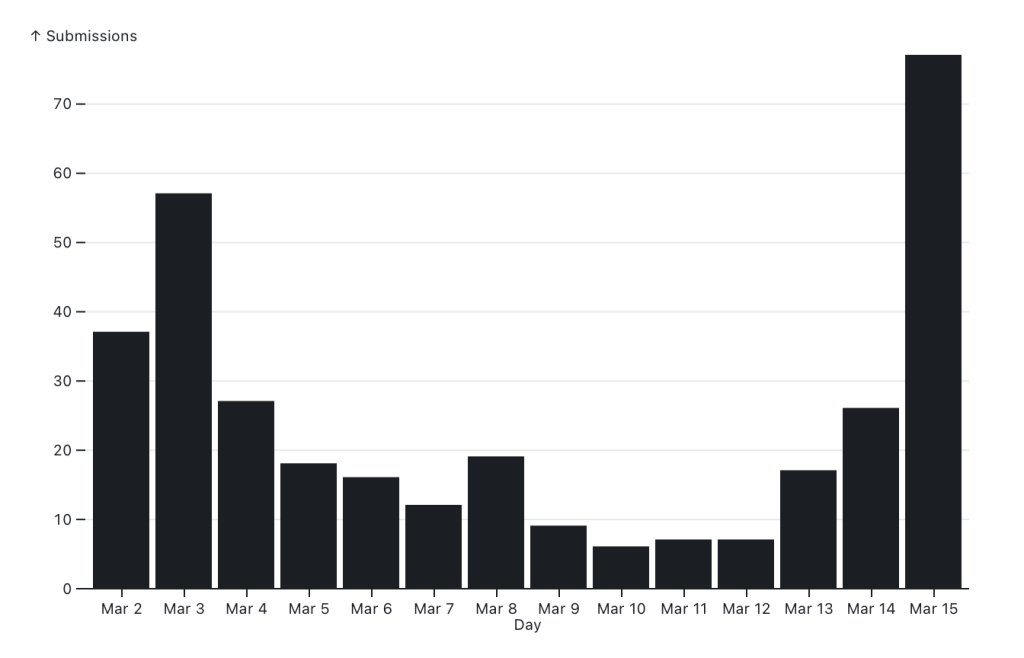
First, the timing of submissions. I received 94 emails in the first two days (March 2–3), 138 emails from March 4–13, and 103 emails in the final two days. Perceived quality was evenly spread across all three periods, meaning people who waited longer did not submit better ideas. I don’t know for sure, but this implies that great ideas were already sitting inside people’s heads, and the public competition didn’t induce many people to generate new ideas. But maybe I’m wrong about this.
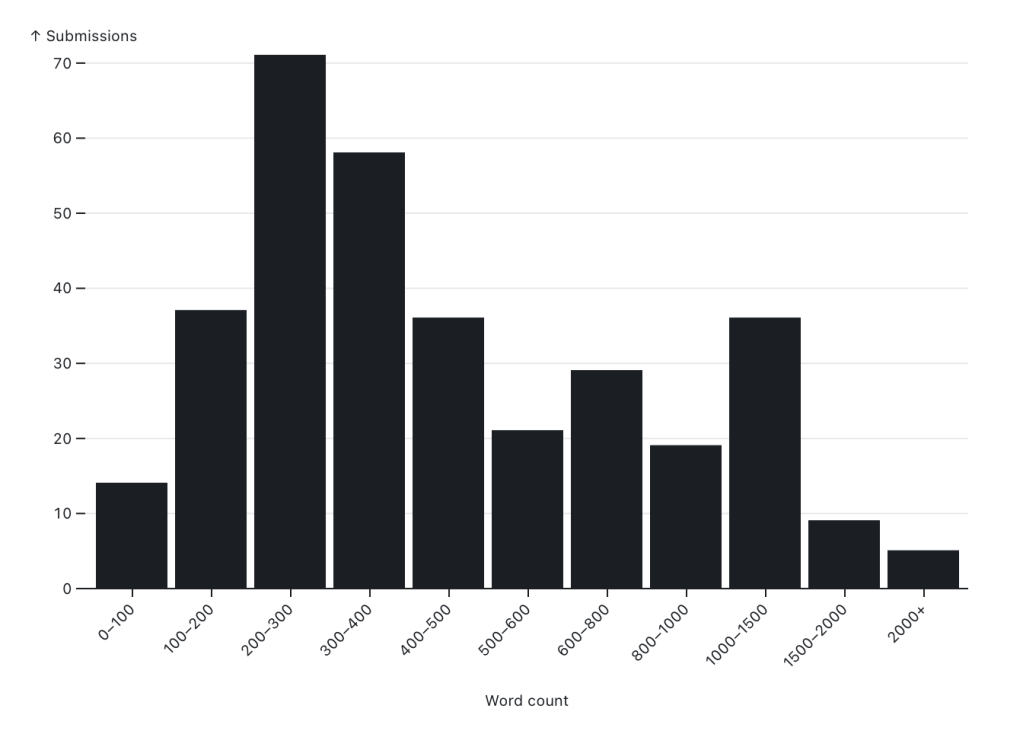
Next, the length of submissions. I specifically said in the public call that “a few paragraphs will suffice.” But the vast majority of people sent me thousands and thousands of words — or sometimes entire, 20-page PDFs — for their ideas. Many academics rehashed their existing papers or PhD theses and sent me the entire document, which I did not enjoy. Many people scraped my blog, found ideas I had already written about (like cell division times), and then used AI tools to rehash my ideas and make them worse. I also did not enjoy this.
Overall, the average submission ran to 548 words. The median was 384 words. Many exceeded 4,000 words! My takeaway is that many people use AI to “expand” their ideas and inflate their word counts, at the cost of clarity and economy of thought. Unsurprisingly, submissions that seemed obviously AI-generated scored much lower than those that felt human.
I scored each submission on originality and tractability. When I couldn’t evaluate an idea myself, I shared it (with permission) with some friends. Ideas often scored poorly because they were obviously derivative — or, in many cases, just verbatim descriptions of tools that already exist — or too vague and speculative to be technically feasible. Of all the ideas I received, I scored 60% as “Poor,” 25% as “Medium,” 10% as “Good,” and 5% as “Great.” There is an element of arbitrariness in these scores (as in all things in life), reflecting my own biases.
I hope to do another round of bounties, albeit on a different topic. If I do, I’d also like to ask submitters directly whether they used AI or agents, and about their affiliation — industry, independent, academic, or something else. I have a hunch that many of the most original ideas came from people in industry, but it’s hard to tell because most people used personal email accounts.
I’d change many other things next time. Instead of using my email address, I’d set up a form that collects more information and automatically curates the data in a spreadsheet. My biggest problem, though, was responding to emails. I wrote a short reply for every submission, and I wish I had an automated platform that just said “Submission received” and, at the end, notified everyone who hadn’t been selected. As it stood, I only had the bandwidth to notify winners, which meant hundreds of other people never got a direct yes or no from me. This is deeply sad to me, because it means many good ideas will never reach the public, and many interesting people who ought to meet each other will not. I regret this and am working on solving these problems.
(Zoe Senón and David Lang, who runs Experiment.com, have good thoughts on this problem. Lang once told me that, when you put out a call for funding and hear from hundreds of people, the good news is that you’ve reached your target audience! Everyone who writes back and shares an idea is your “ilk;” the kinds of people who share your interests. And yet only about 5 percent of them will receive money. The rest may leave feeling sad, or jaded, or nothing at all. Sending thoughtful rejections — which I didn’t do because of the sheer volume of emails — builds goodwill and camaraderie within the community.)
Despite the flaws in this competition, though, I think it was a successful experiment. I’m sharing a few of the winners below, along with a sentence or two on what they proposed. I’ll expand on more of the winning ideas on this blog over the coming weeks.
- Sebastian Cocioba for a laser-based PCR thermocycler, in which infrared heating replaces aluminum blocks. (Public notebook here.)
- Lou Hom for an idea to run cell-free protein synthesis reactions on a gel filtration column, such that ribosomes continuously encounter fresh substrates while physically migrating past their waste and spent nutrients.
- Bryan Duoto for a colony-to-sequence cloning workflow that uses magnetic beads and Nanopore sequencers. Scientists can verify clones in 1–3 hours instead of waiting overnight. (Public protocol here.)
- Jeff Nivala for an idea to synthesize proteins directly from DNA, without relying on any RNA intermediates.
- Sierra Bedwell for a clever automation system that uses off-the-shelf parts to combine a thermocycler, gel imager, and liquid handler to screen thousands of environmental DNA samples in parallel.
- Xavier Bower for “IceCreamClone,” an interactive cloning strategy ranker that looks at a scientist’s available “parts,” or sequences, and then determines whether they ought to use Gibson, Golden Gate, restriction digest, or another strategy to assemble them together. The software also catches likely cloning errors and estimates the cost and time required for each option. (Software demo here.)
- Andres Arango for two ideas: using antifreeze to accelerate DNA ligation by 2-3 orders of magnitude, and computationally designed protein cradles for expressing membrane proteins in E. coli.
- Corey Howe for ideas to speed up Vibrio natriegens growth using 3D-printed mini-bioreactors and continuous whole-genome sequencing.
- Alexander Vawter, from Heterodox Labs, for the “Experiment Engine,” a series of cameras and sensors that help debug experiments at the bench.
- Michael Darcy for three highly original ideas, including a protein printer fabricated using DNA origami and a “GPU for liquid handling” device which uses a centrifuge, instead of pipettes or sonication, to move droplets.
I’m under no illusions that these tiny grants will meaningfully push these projects forward. A $500 or $1,000 check often isn’t even enough to buy reagents for experiments. But these microgrants act as a vote of confidence. They tell people that I believe in them and that I think their ideas are good. In that way, a small amount of money can subtly shift the trajectory of what people choose to work on.
More importantly, I’m encouraged that this bounty incentivized hundreds of people to think about the methods they use every day and consider ways to improve them. This is good for science, because good things happen when scientists think explicitly about the limits of their tools. (That is why a frustrated postdoc invented the micropipette; he got annoyed by using his mouth to move liquids around.)
As always, please write to me if you’d like to talk more. I’m at nsmccarty3@gmail.com.
